We’re Basically Flooding

As any submariner will attest, few things scare you as much as the 1MC blaring “FLOODING IN THE ENGINE ROOM!” Submarines, you see, don’t float particularly well and when more water is coming in than is being pumped out, you become concerned, trending towards frightened.

Date: circa 1978

Location: somewhere east of Guam, over the Marianas Trench

Setting: onboard the fleet ballistic missile submarine USS Sam Houston (SSBN609)

There was no such 1MC announcement of impending doom. There were no semi-panicked sailors rushing about attempting to stave off said doom. No,  all was quiet in AMR2LL. Well, as quiet as it gets while underway what with pumps running, steam and water coursing through pipes. Which is not remotely quiet, truth be told.

But we were still flooding. At least I thought so and judging by the concerned expressions and comments of my fellow nukes, I wasn’t the Lone Ranger in that opinion. There was definitely more water – a lot more water – coming in through that crappy drain pump shaft seal, as well as other holes in the boat, than the pump could expel outside the hull. Soon, we would all die a horrible, crushing death.

So why no 1MC, no panic? Why weren’t we blowing ballast and driving to the surface? Simple – the boat was at test depth to test the integrity of the systems, including the seawater piping and pump shaft seals. We did this after every refit, which occurred three or four times a year. The captain would take the boat as deep as operationally allowed and the crew would check for leaks. And leak the boat did, every time. The enormous pressure at depth was just too much for the seals and pumps to resist entirely.

Normally, this evolution was routine. Dive deep, note where the water was coming in and how fast, take her back up. This time, however, as we stood around watching the bilge water depth increasing, we weren’t coming up. The boat remained at test depth for a really long time, much longer than required to do the leak test. And still the water poured in. We were getting concerned.

Let me digress a bit and explain a fundamental characteristic of our crew. You could divide us into groups based on a couple of things – the nukes vs the forward pukes being the clearest. Nukes are engineers; everyone else isn’t. But you could also divide us, albeit less clearly, by our love for the navy. You had the ‘diggits’ who were in for life and you had the dissidents who were actively counting DTGs (days to go). I was in the latter group. There were more diggits among the non-nukes but we had our share, too. One thing diggits liked to do was re-enlist and one thing the captain (aka Chief Diggit) liked to do was make a show of re-enlistment ceremonies.

Let’s get back to the flooding. Why were we still at test depth? Why, the captain was conducting re-enlistment ceremonies in the control room. While we were basically flooding back aft.

My wife tells me that I told her that I reacted somewhat emotionally when we learned what was going on. The story goes that I expressed my displeasure with the captain quite forcefully over the whole episode. I don’t remember doing that but it sounds good.

In any case, we made it back from the depths alive. It might even have been the time the captain did an emergency blow from test depth. That was an experience. At great depth, the high pressure air banks don’t have nearly the ummph to displace all the water from the ballast tanks. So the boat doesn’t rise very fast at first. In fact, it’s almost imperceptible. But slowly, the air in the ballast tanks wins the battle with the water and the boat’s rise picks up speed. And also adopts a serious ‘up’ angle. By the time we hit the surface, the sub had enough angle and impetus to drive a third or so of its length out of the water before crashing back down on the surface. It’s fun. You can see videos of subs doing this on the internet, and I believe also in the movie Hunt For Red October.

So, yeah. Test depth. Loads of fun.
P-K4

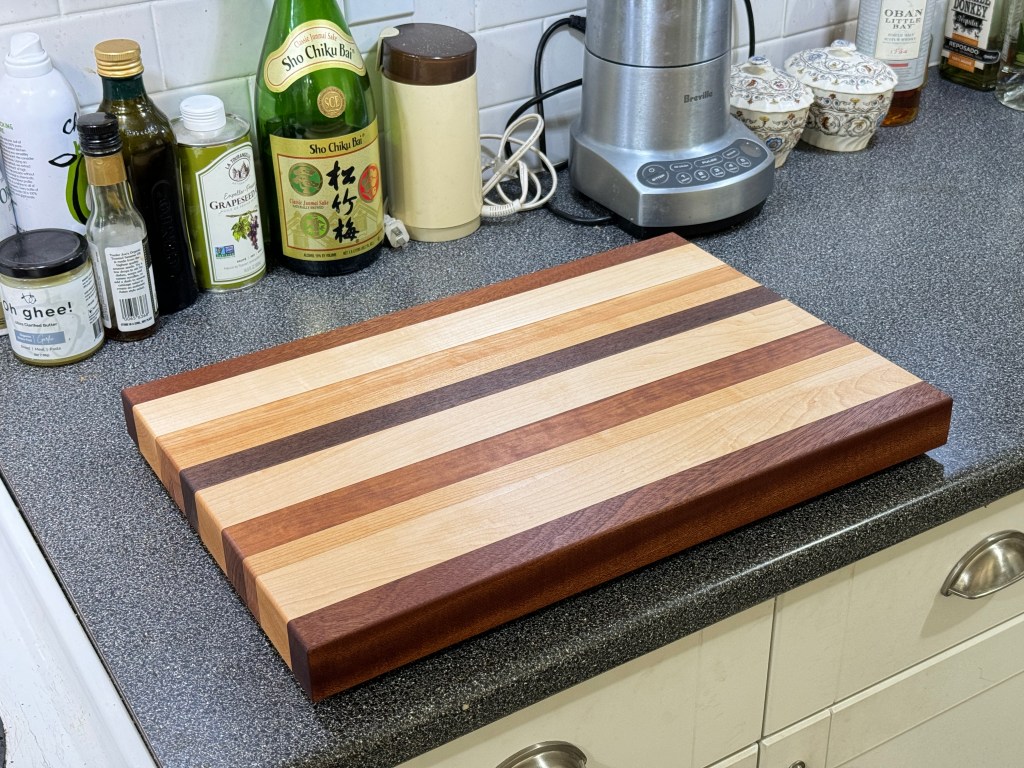
It’s said that every woodworker must make at least one cutting board (sometimes also known as a butcher block or chopping board). Those are the rules. Not being a rule-breaking scofflaw, I decided this year to get that task out of the way, but with a further purpose in mind.

There are two basic types of cutting boards: end grain and edge grain (there’s also face grain but that seems like a subcategory of edge grain to me). End grain, with the wood grains lying perpendicular to the cutting surface, are said to be easier on knives and more durable. Edge grain boards are easier to maintain and generally cost less (if you’re buying one, not making one). I have both types in my kitchen but for this first one made in my shop, I chose edge grain.

Cutting boards are typically made of hardwood, often more than one species. Maple is common, as are walnut, cherry and ash. The wood should be tight-grained. Open pore woods such as oak, which is a hardwood, are deemed unsuitable as the pores will capture food particles and encourage bacteria. For mine, I looked first to my existing wood supply and found some workable walnut, mahogany and ash pieces. But no maple, which I really wanted, so I bought some at the local hardwood store. Also picked up a piece of sapele.

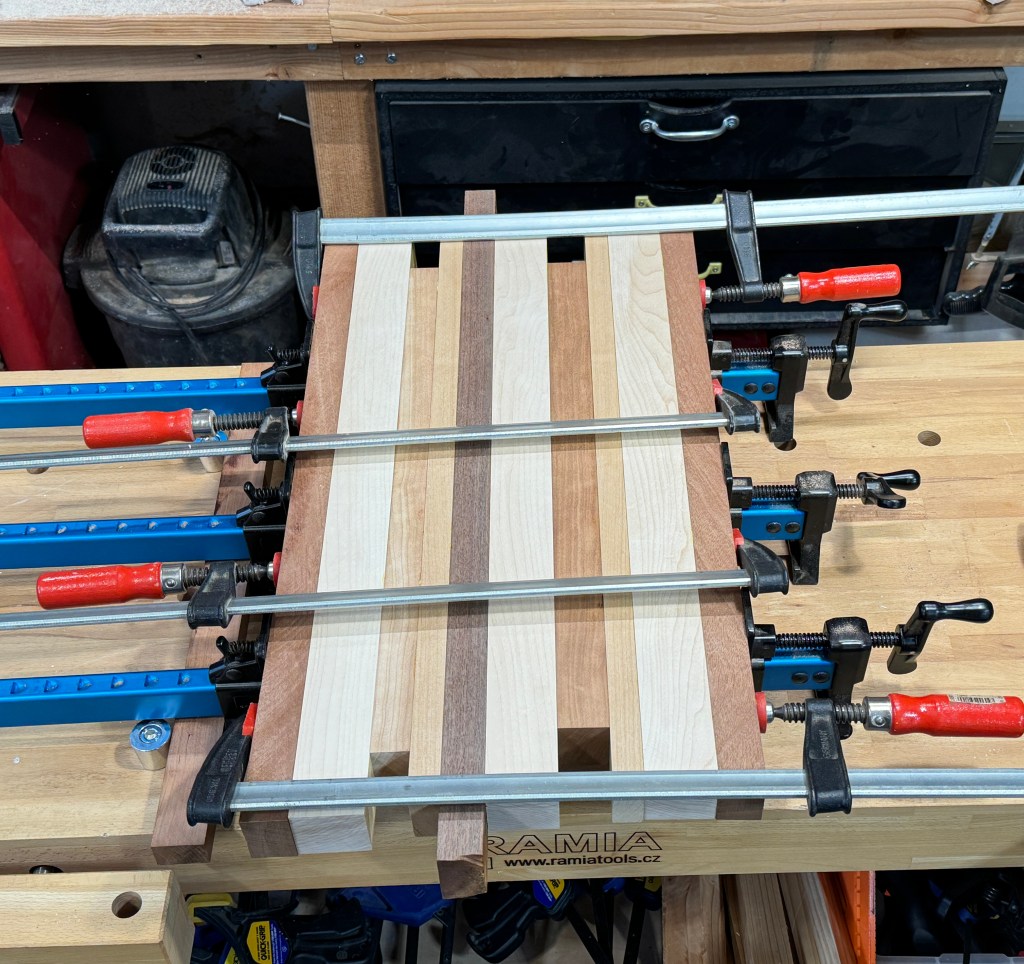
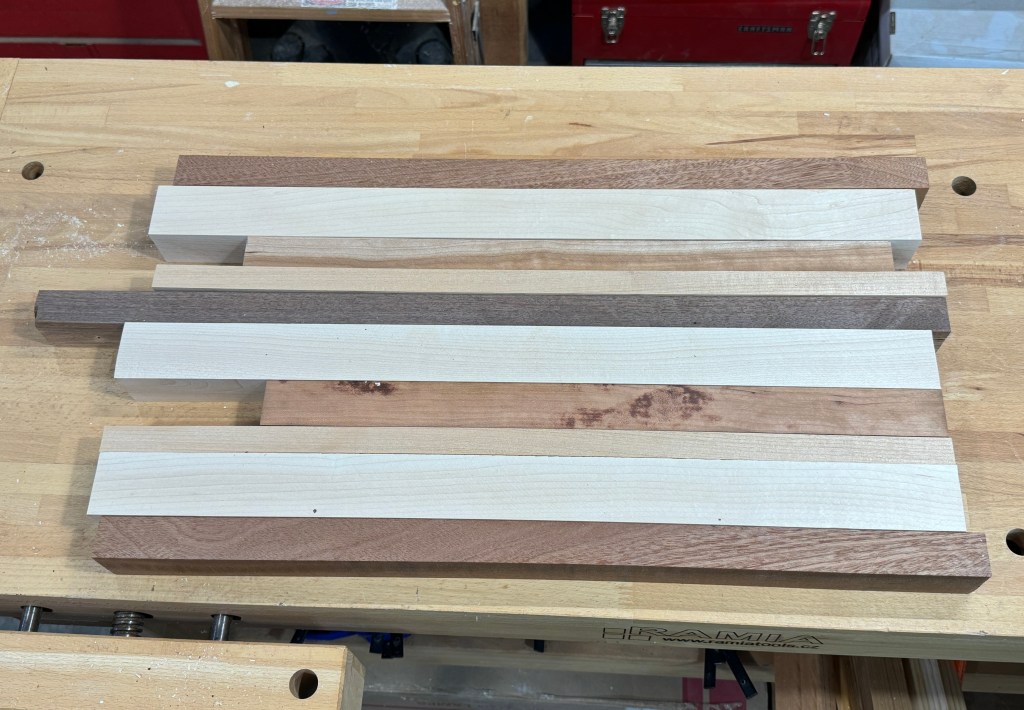
After sizing the various pieces more or less to width on the table saw, and keeping the maximum width of my planer in mind (13″) here’s the layout:

Next step is the glue-up, ensuring the entire face of each piece is coated with glue:

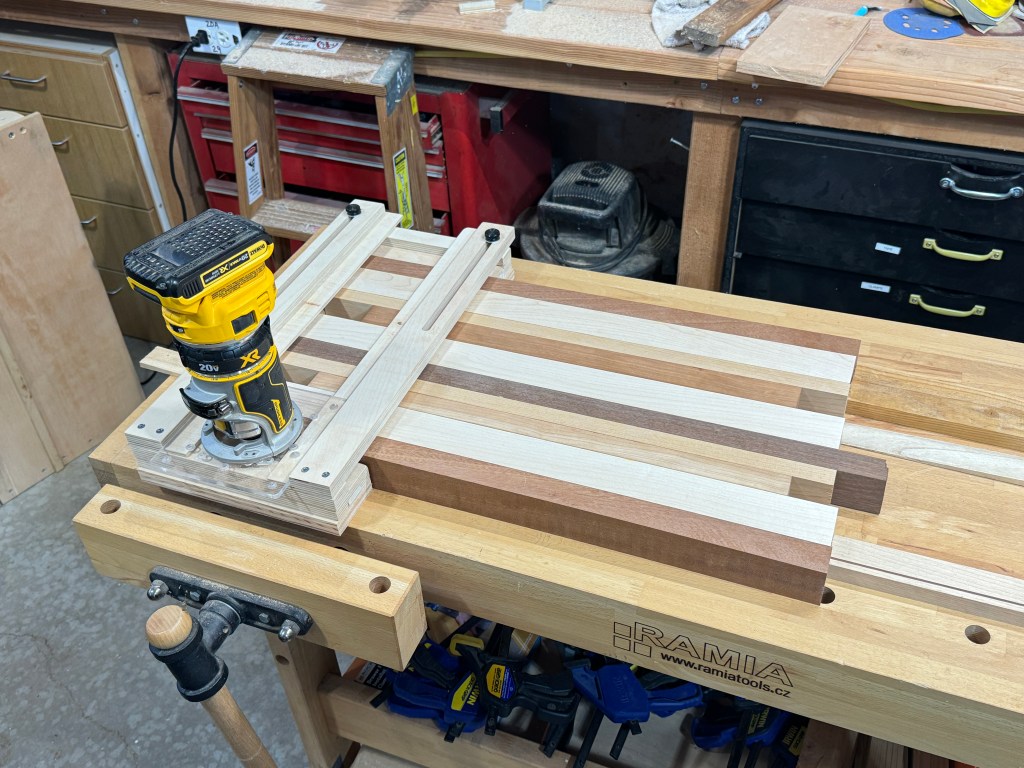
I could have done a better job of sizing the pieces at the table saw such that the top surface would be almost perfectly flat after glue-up but I didn’t, maybe because I was anxious to use my new flattening jig. I could have used the planer to do all the flattening but, as I said, I wanted to use the jig which employs a sliding frame that holds a compact router at a consistent height above the piece. You pass the router – equipped with a flattening bit – back and forth as you slid the jig along the length of the piece. Works pretty well although produces a prodigious amount of dust/cuttings.

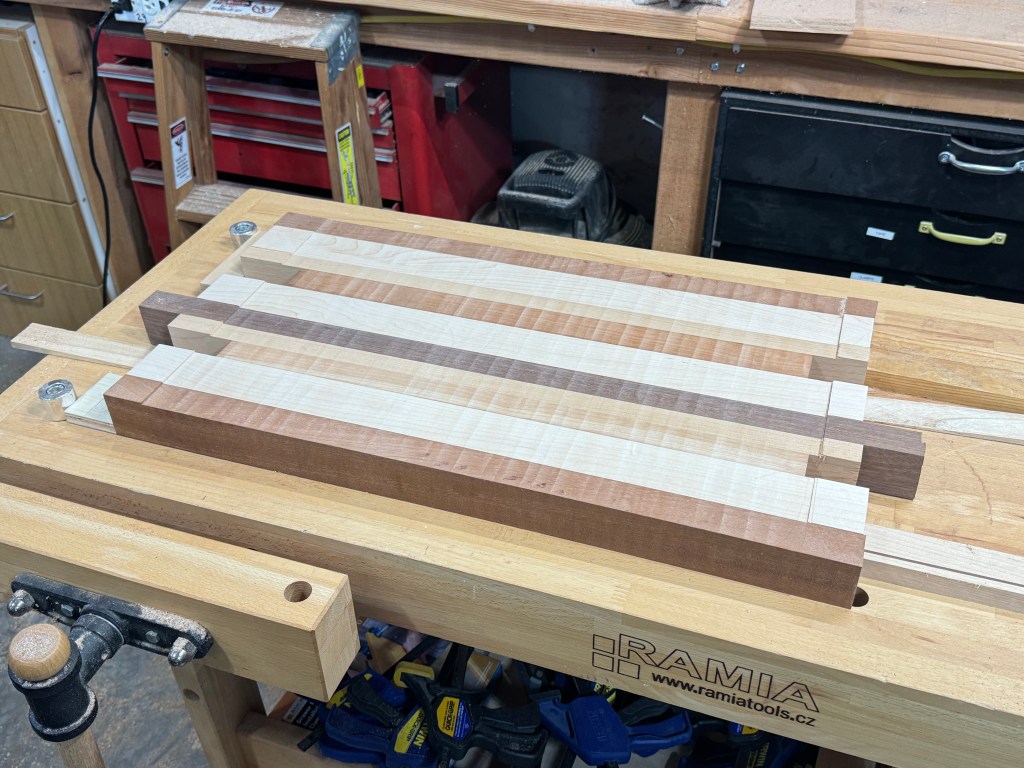
Next is cutting off the two ends and running it through the thickness planer:

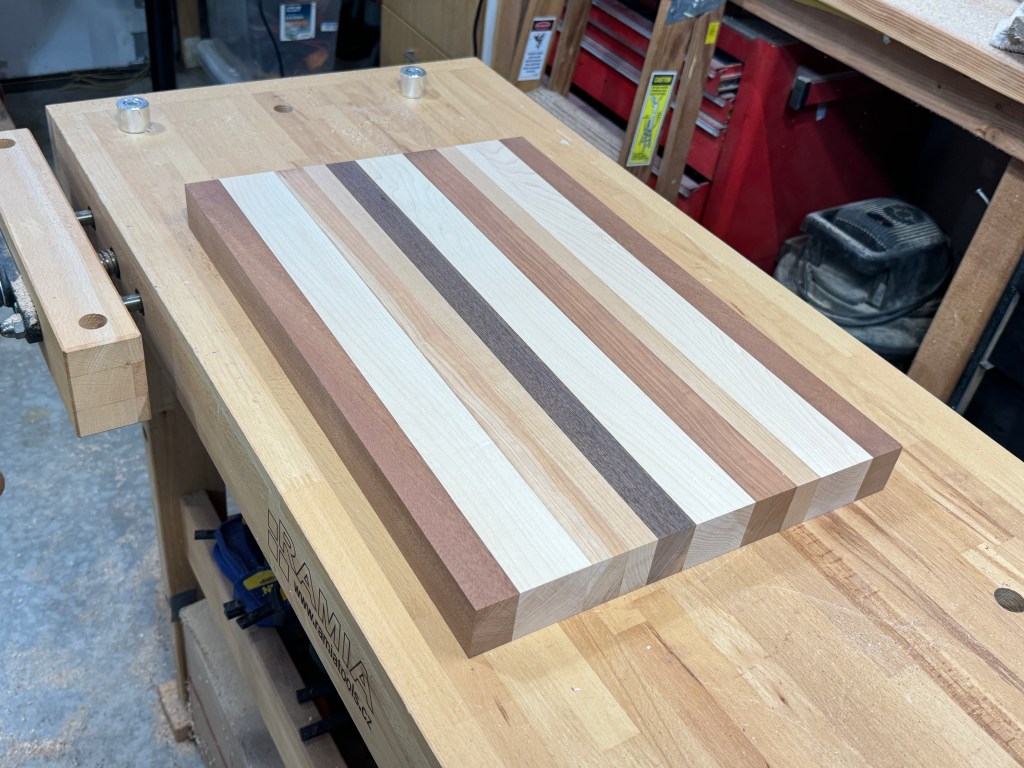
Round off the edges, finish with a few coats of tung oil, install rubber feet, and this is the result:

I think it turned out pretty well.

So, why is this post titled P-K4? As I alluded to in the beginning, I had a further purpose. The cutting board was just practice; I didn’t need a new board. No, I wanted to make a different type of edge grain board: a chessboard!

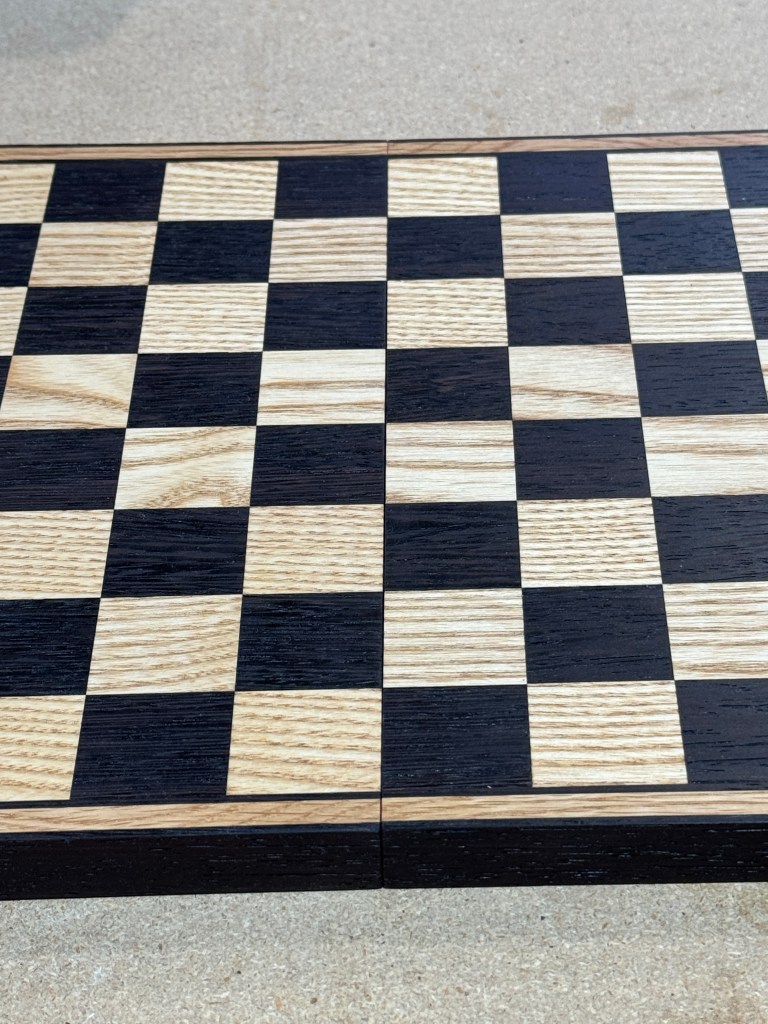
I ended up making three chessboards. The first was meant to be practice but it turned out well enough to call it good. The second and third were to be different styles: one a single piece and one that would fold in half. After I made the first board, I decided they needed edging to extend the footprint beyond the playing surface a bit. For wood, I needed two very disparate species. I had a lot of wenge on hand – a very dark, black wood. For the white squares, I decided on white oak but I didn’t have enough so off to the hardwood store again.

The edging was in two styles. The first and second boards received a sandwich of thin wenge/fatter white oak/thin wenge. The third got thin padauk/fatter white oak/ thin padauk. Padauk is a red wood which actually changed the final appearance of the entire board a bit, as we’ll see. To accommodate the foldy nature of the second board, the edging is flush with the playing surface. The other two have playing surfaces that are about 1/16 inch proud of the edging. To ensure structural integrity, all three have corner splices.

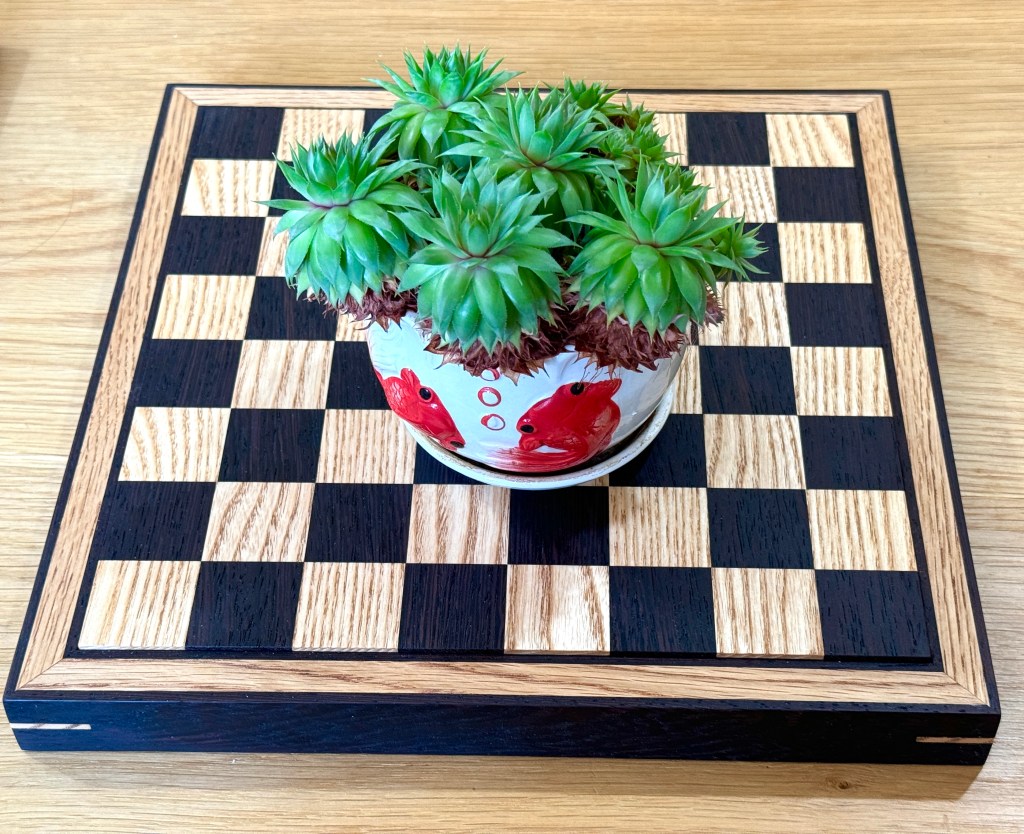
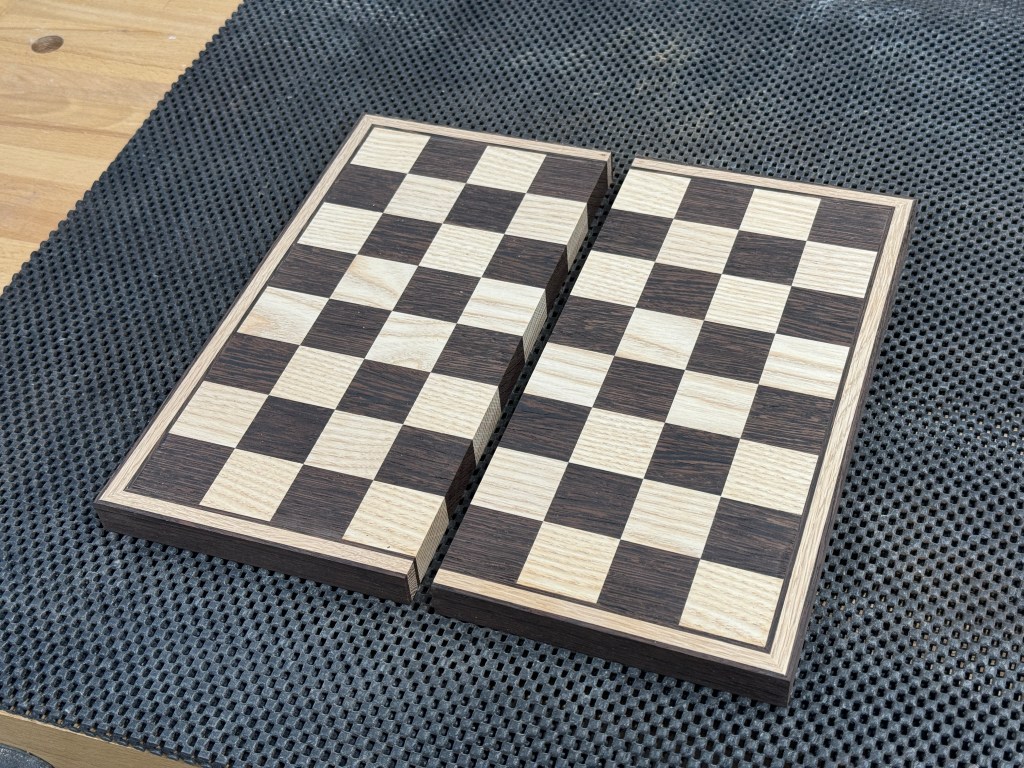
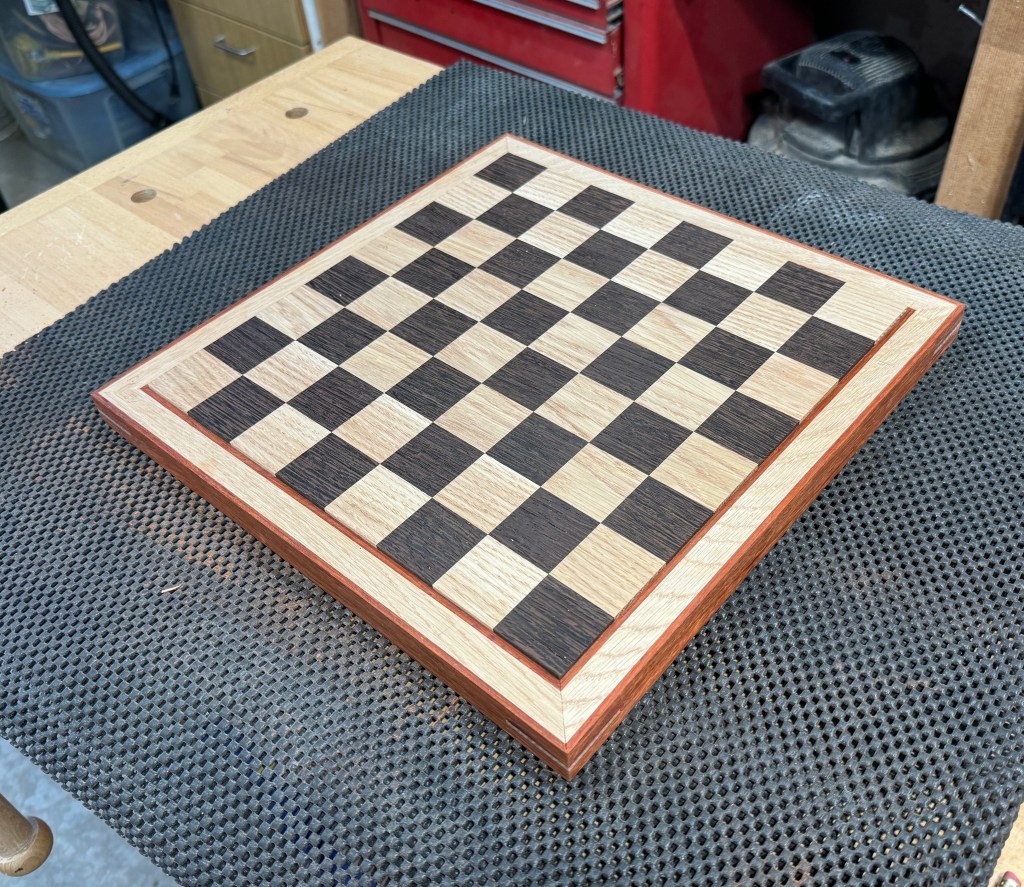
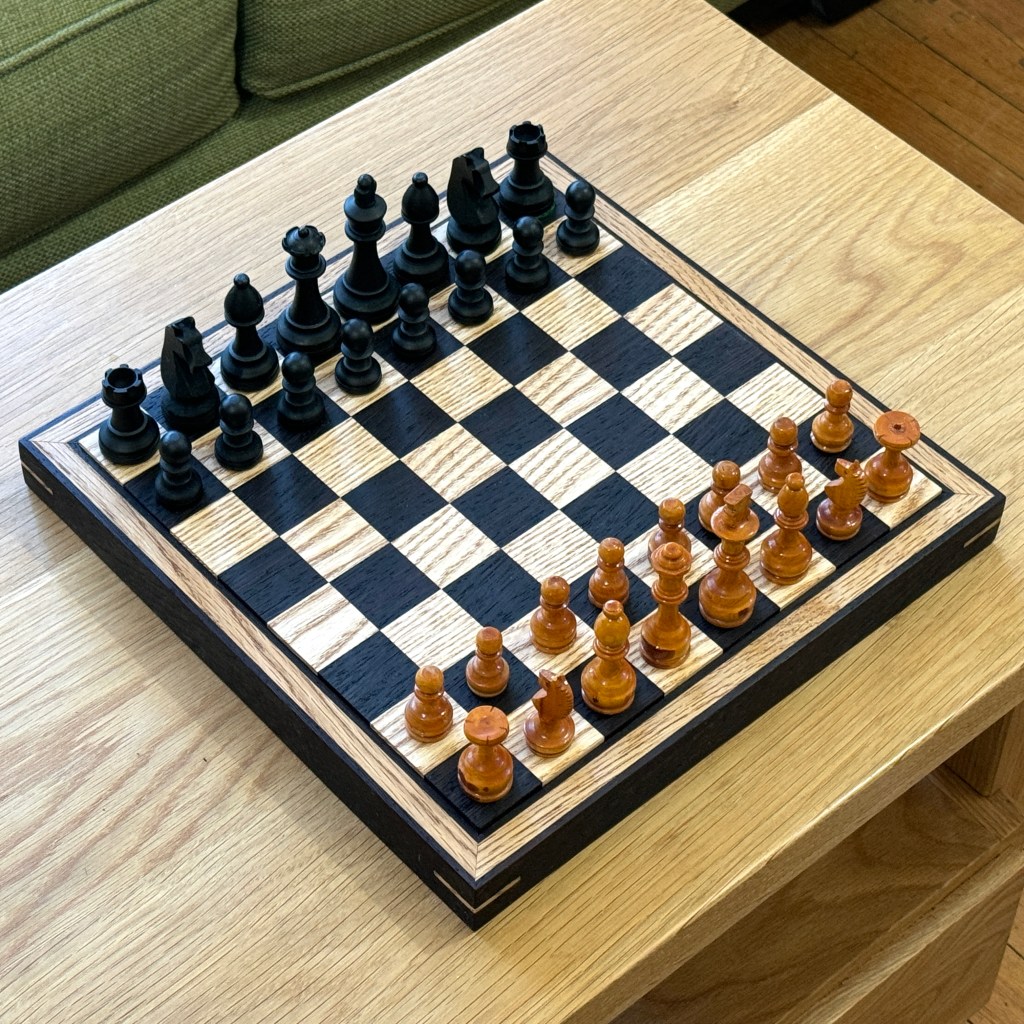
I’ll just go ahead and present all three to save readers the suspense. In order of build:

All three eventually were finished with wipe-on poly. You’ll notice that the first board has a succulent plant sitting on top. Seeing as I really didn’t need three new chessboards (besides the one I already had), I traded it for that nice potted plant.

The build. As mentioned, the initial process is much like a cutting board: cut wood strips to size on the table saw and glue them up. It’s important that the eight strips are exactly the same width.

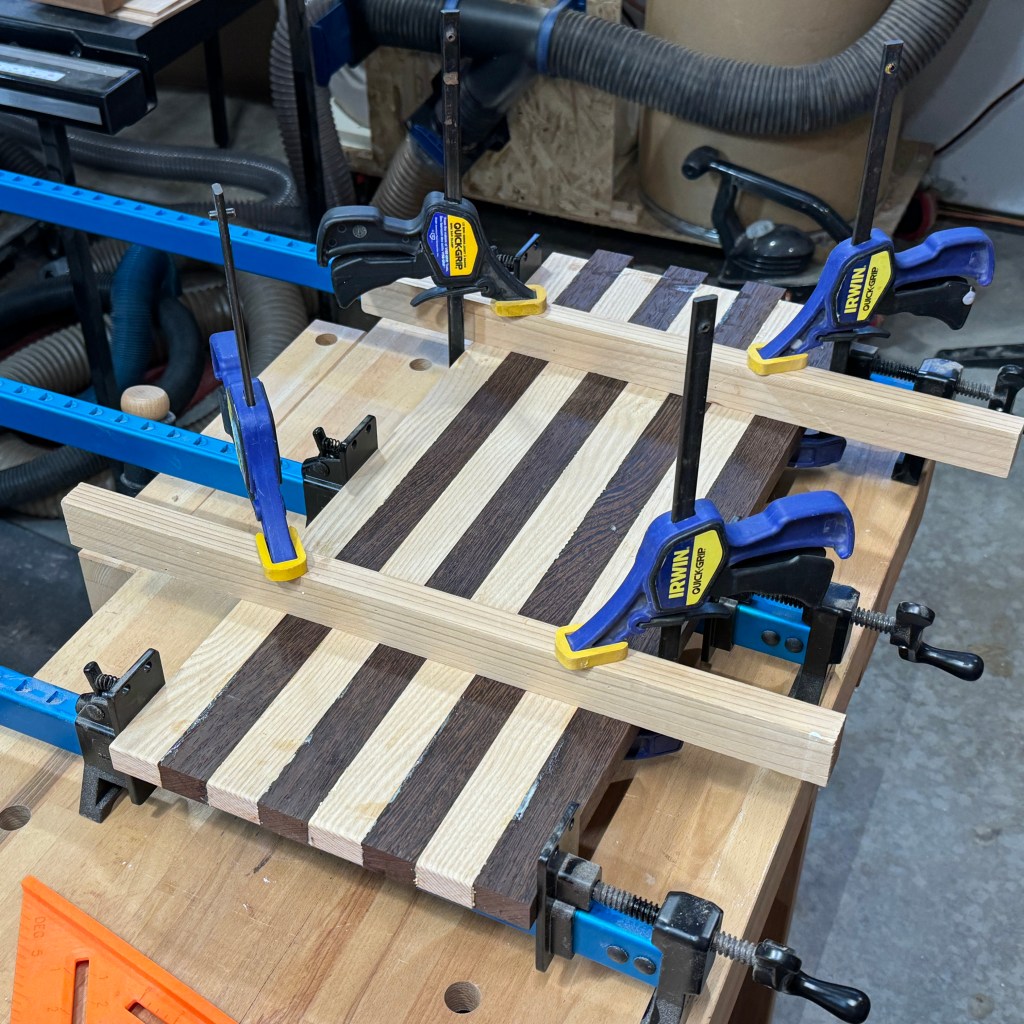
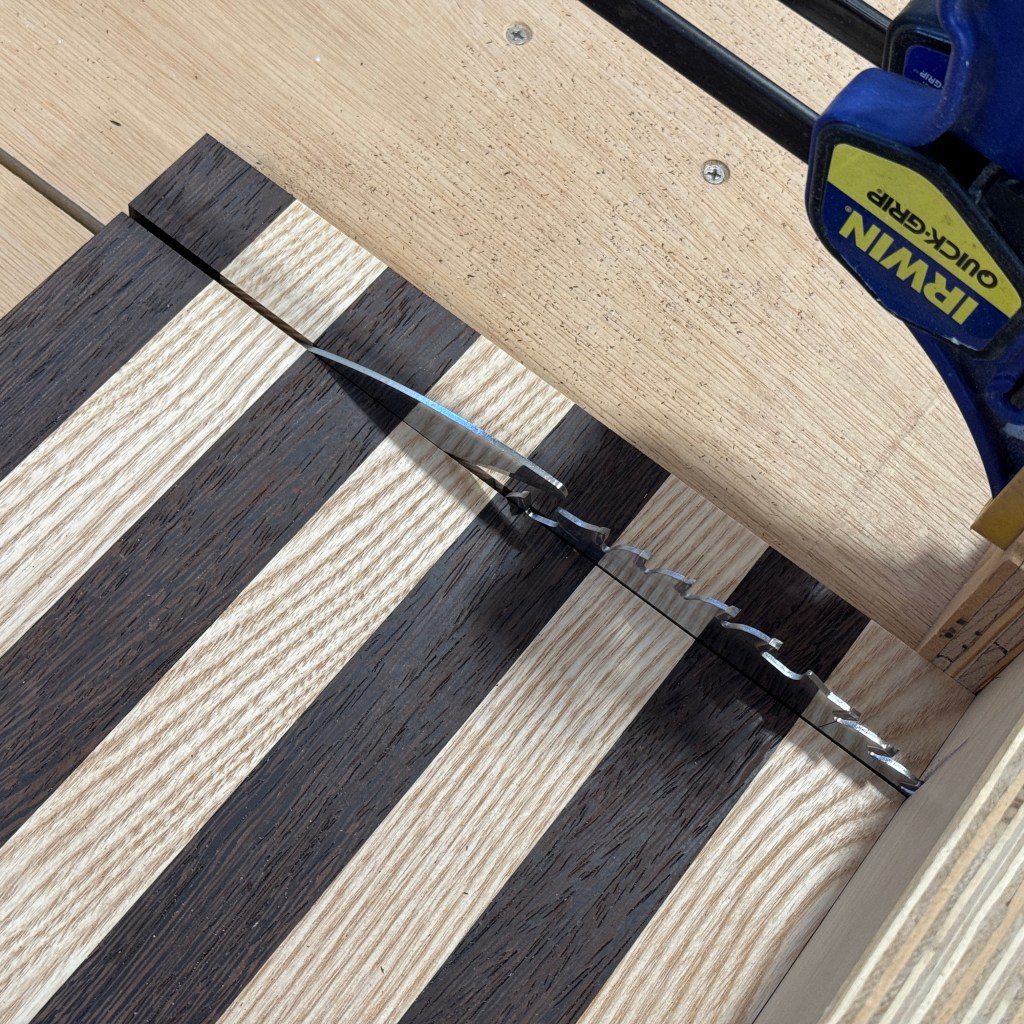
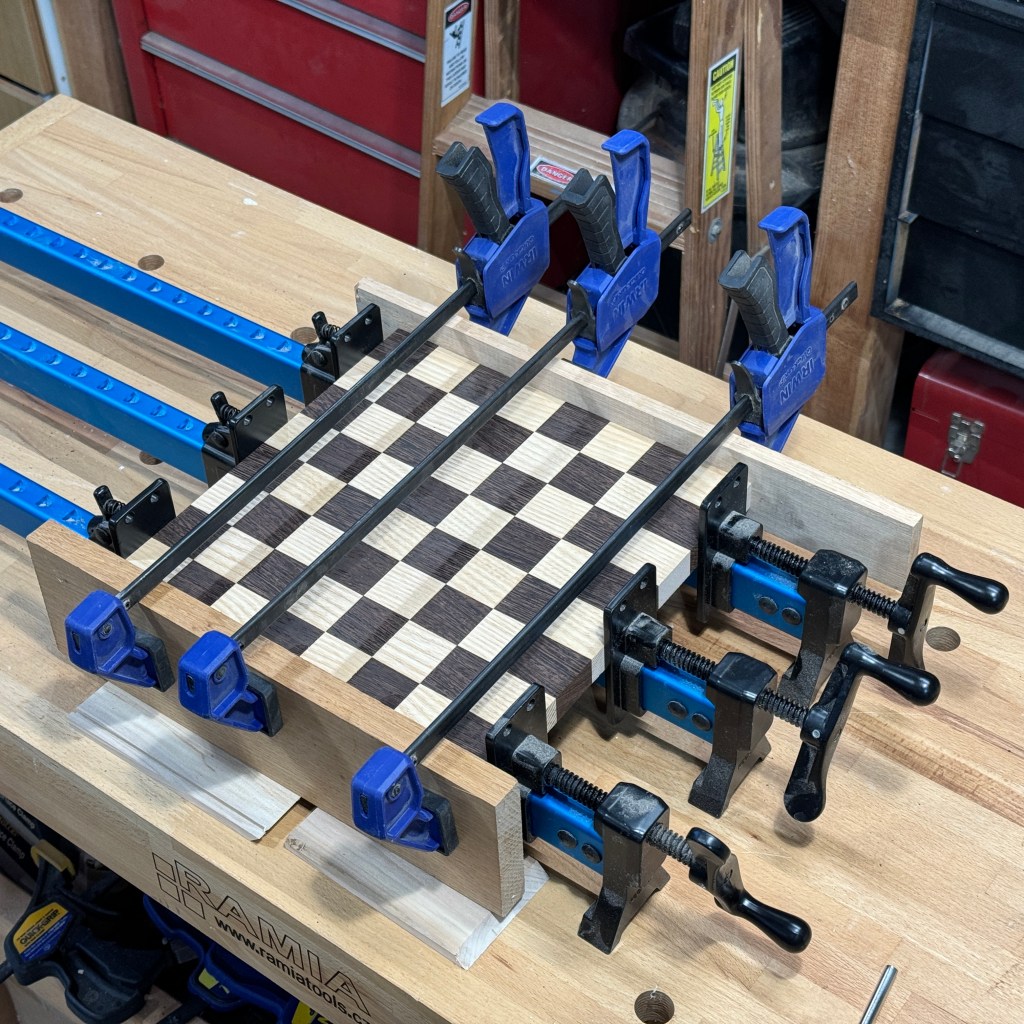
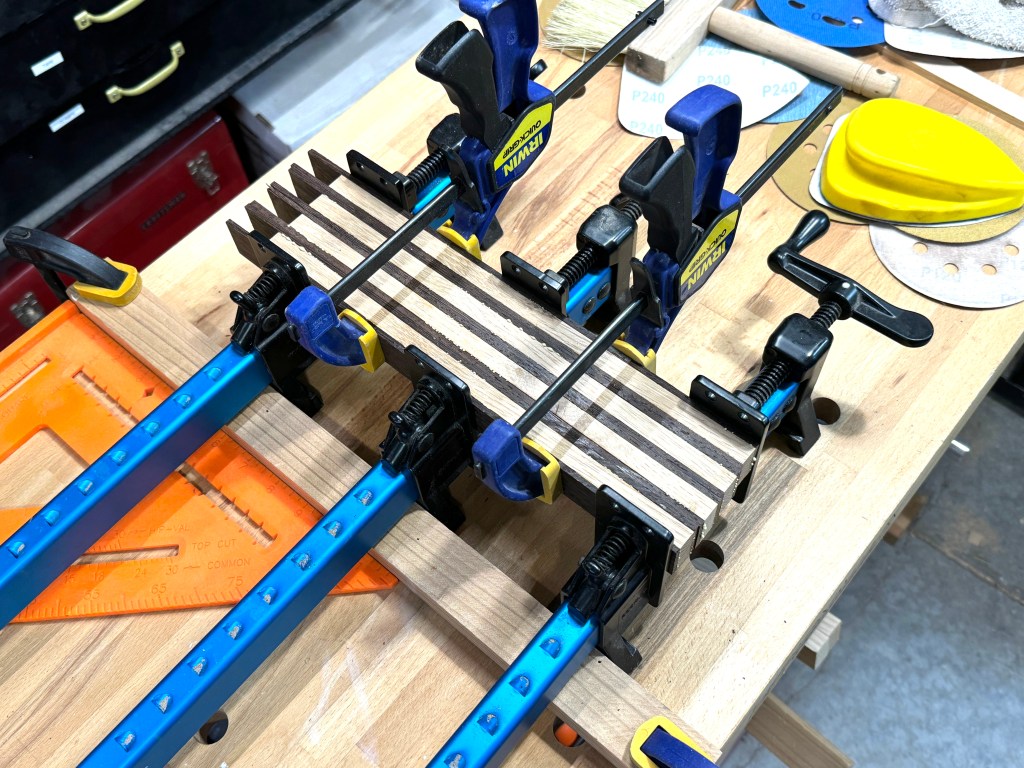
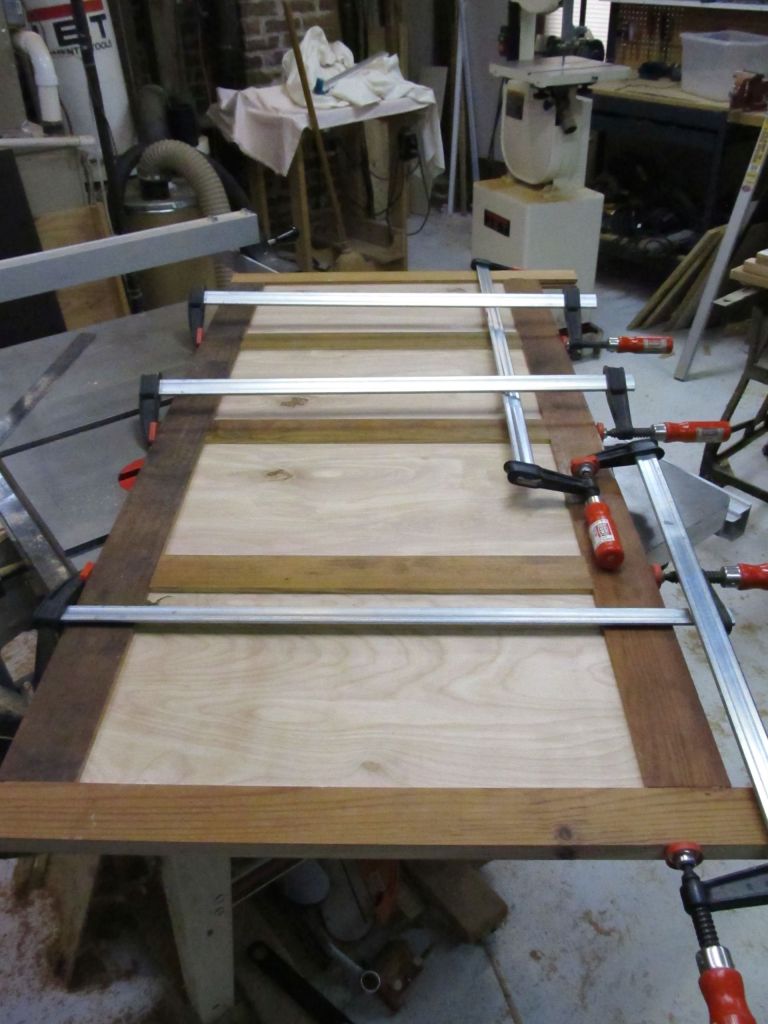
Next, after running it through the planer to get it nice and flat, cut eight strips across the grain. Here again, it’s important to measure carefully so the width of the cross-strips is the same as the width of the original strips, resulting in alternating squares, not rectangles. I used precision calipers but probably could have used a scrap piece of the original strips. Glue up those strips with the colors alternating. I used two edge boards in the clamping process to ensure the glue joints didn’t slip. Note that for the second board, which was to be a folding style, I cut one strip exactly one blade-width wider and glued it in the middle.

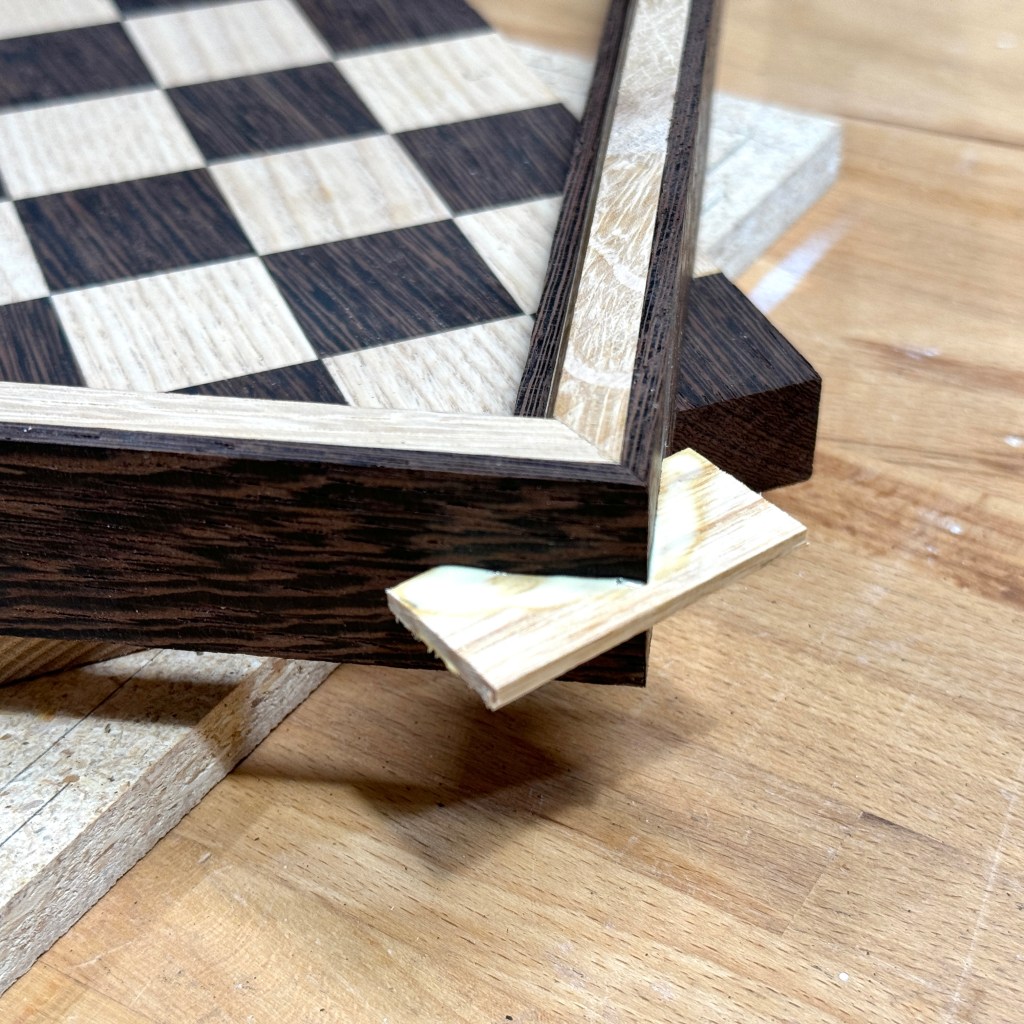
On to the edging for the first board (process duplicated for the third board). Here, I needed to be careful. Because wood tends to shrink or expand with seasonal humidity changes, I couldn’t just glue the edging to the side of the board. It would eventually fail, probably. After consulting online sources, I decided the solution was to use a square of MDF (medium density fiberboard), which doesn’t shrink or expand. The MDF would be about 1/4 inch bigger on all sides than the board. I then would glue the edging strips to the MDF. Finally, I would insert the board inside the edging and secure it on the bottom with good double-sided tape. That was the plan, one that would require a bit of care to ensure the board fit snugly inside without gaps showing. Much to my surprise, it worked! Hopefully, these photos show the process:

Looks like that last photo of the corner splices is a bit out of focus. Here’s the board finished and in action. The white pieces are from my old board that I got in Mexico a hundred years ago. The slightly larger black pieces are a set I bought online. Testing to see what size best fit the board.

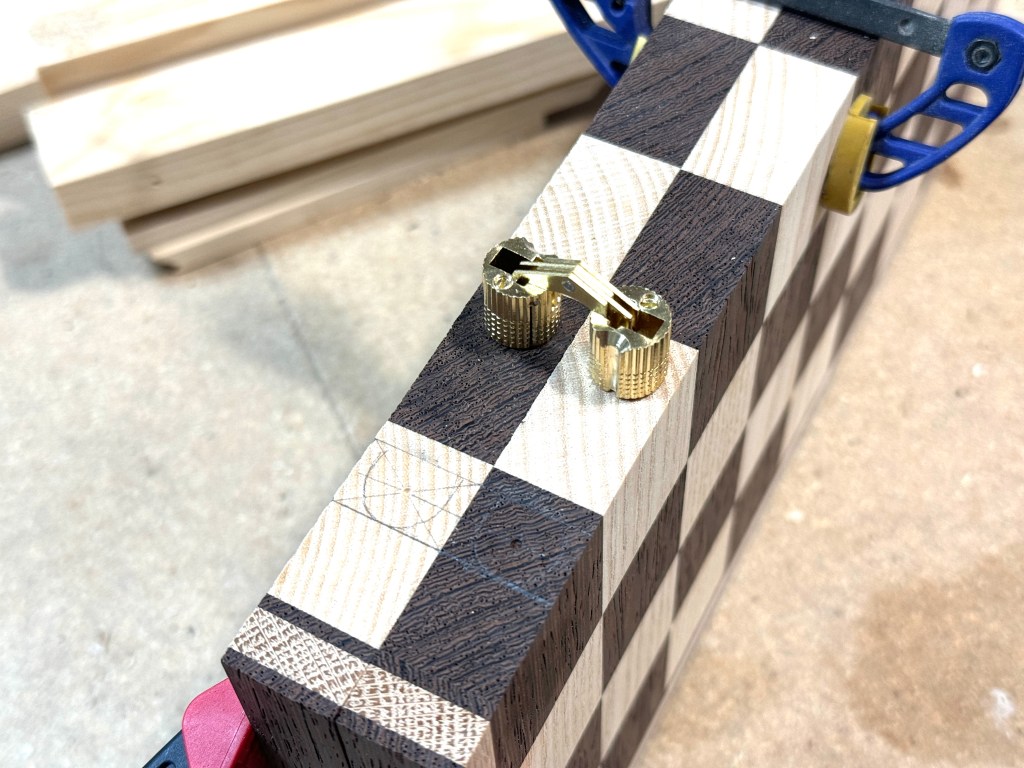
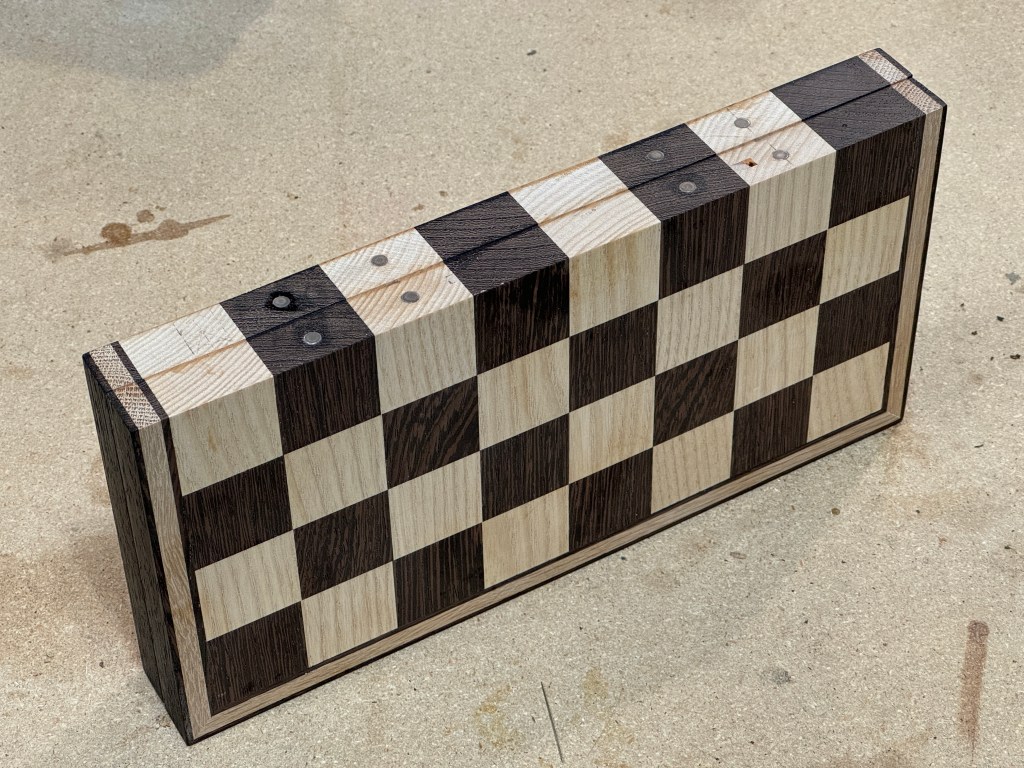
The second, folding board didn’t work out well, at least not the folding part. I initially thought to use barrel hinges but couldn’t get them to work such that the board opened and closed flat with no gap. I gave up and used small magnets instead. The two pieces are separate but come together to form a complete, flat playing surface, held by the magnets. Not sure it will get much use – I may trade it for second succulent plant!

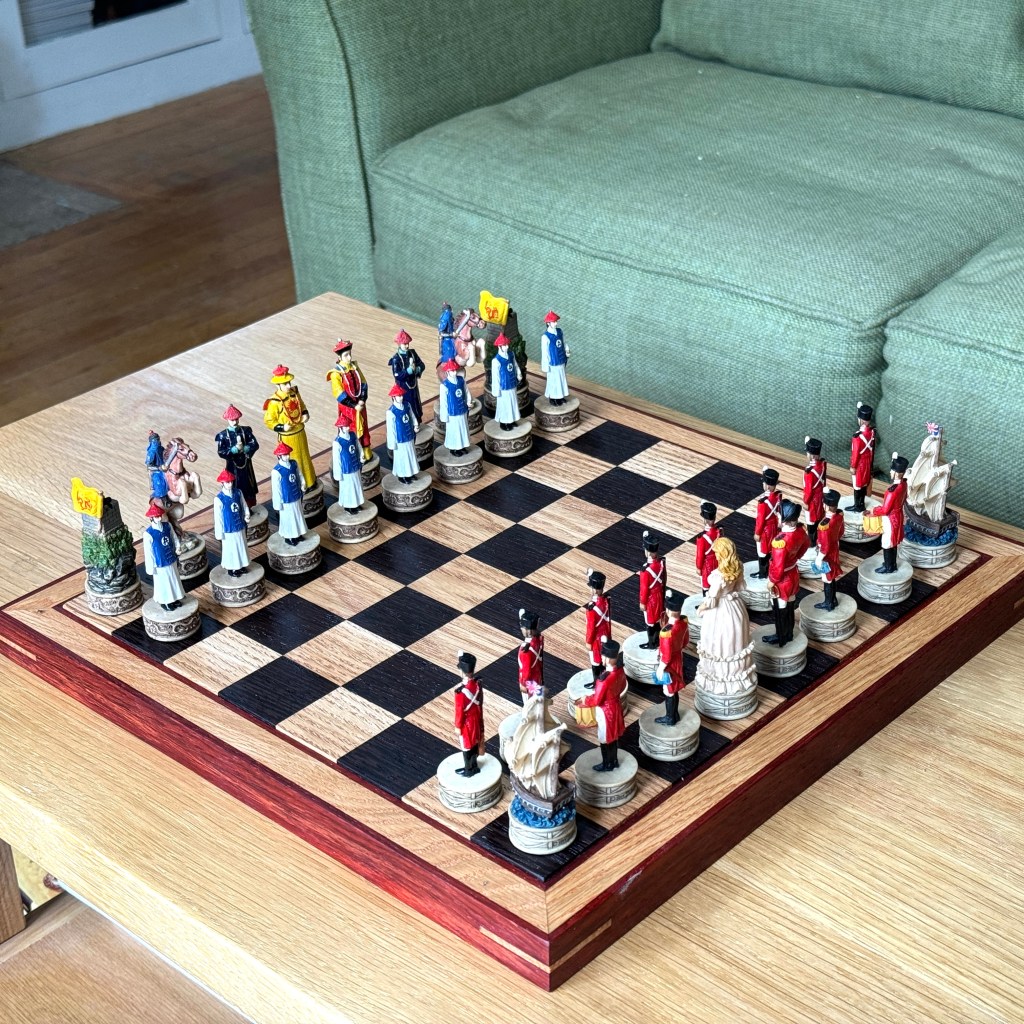
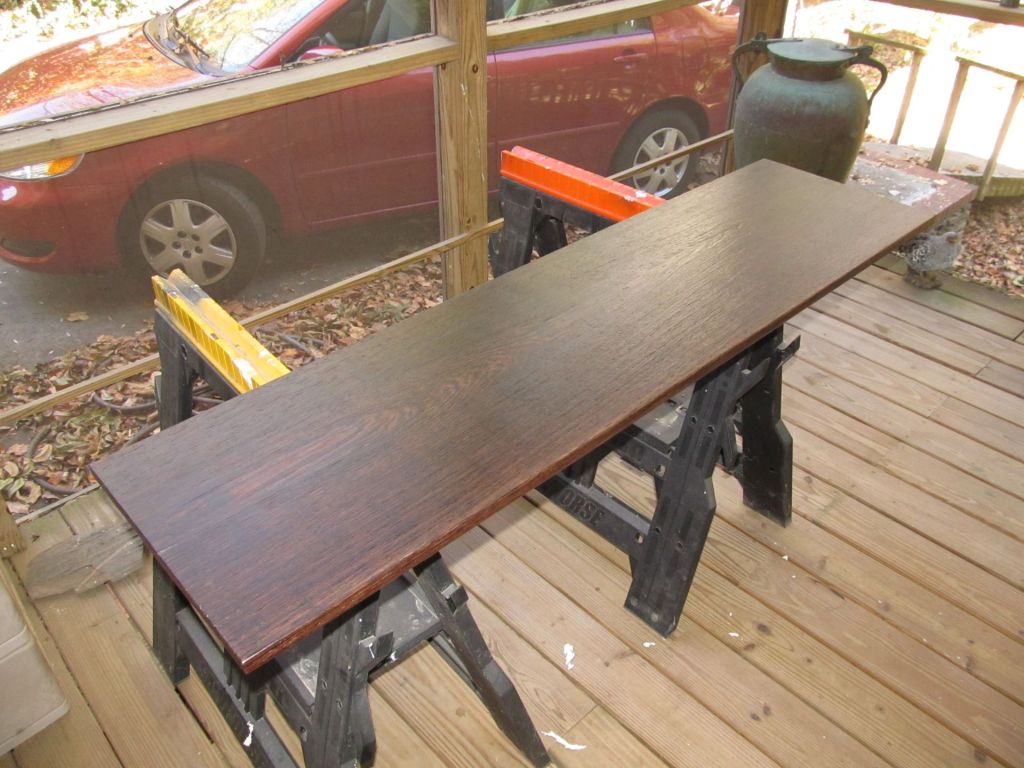
Finally, the third board. Fashioned the same as the first except with padauk edging, it’s a bit bigger than the other two. About that padauk. When sanded, it produces a very fine red dust. The other wood is white oak, which along with being white, has the typical open pores found with all oaks. Red dust + open white pores = slightly red white edging. The white isn’t so white anymore after all that dust got in the pores. I couldn’t get it out completely. So, despite being made of the same species – wenge and white oak – the third board looks different. And that’s fine. I like it.

I didn’t give away any chess pieces with the second board, so the ones I bought online will be used with this one. For now. What I really want is a nice old set of wood pieces. I look for them at garage sales, thrift stores, etc. While in Hawaii (Chinatown) this past year, I found a really cool set of painted resin pieces made by a company that designed them in the style of historic armies. The set I bought pits the English and Chinese circa 17th or 18th century (I think), back when the European powers were beginning to explore and exploit the Far East, maybe later. While definitely unique, they are a little disconcerting to play with the because some of the pieces don’t look ‘normal,’ particularly the English side: a sailing ship for the rook, drummer for the knight and a slightly taller guy without a drum for the bishop. The Chinese king and queen are hard to tell apart at first, too. I’ll keep a lookout for better chess pieces.

Cutting board and chess boards – fun projects.

Wonder What the Pets Are Doing?

“Wonder what the pets are doing?” We would often ask ourselves that upon returning home from a day trip or longer, imagining catching them in the middle of a wild party or possibly passed out from the aftereffects of one last night. We still do that – ask ourselves what the pets are doing – even today. But see, since Andy died last Fall, for the first time in our married life, we don’t actually have any pets. They’re all gone. We come home to an empty house. Andy (eldest, Queen Kitty), Koda (The Mutt, Queen Koda) and Chuck (the boy cat, My Little Buddy) all passed away within the past few years. It’s bad enough when one pet dies but when they all go, leaving a pet vacuum behind, it’s really tough. We miss them all terribly.

Shut the Box

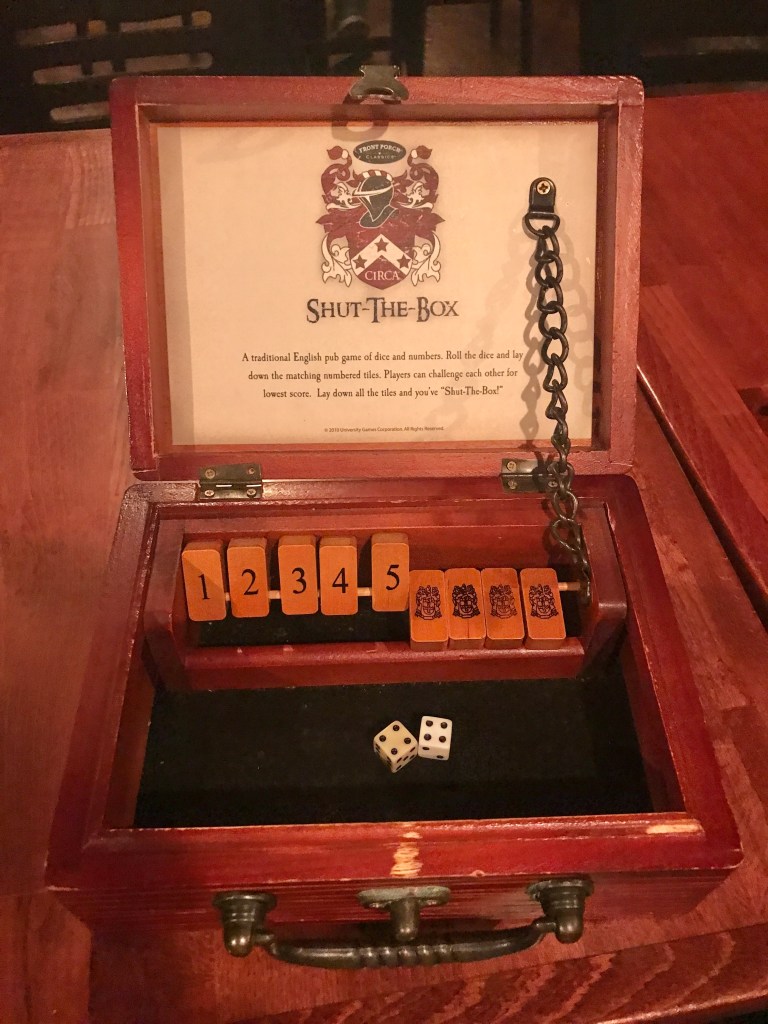
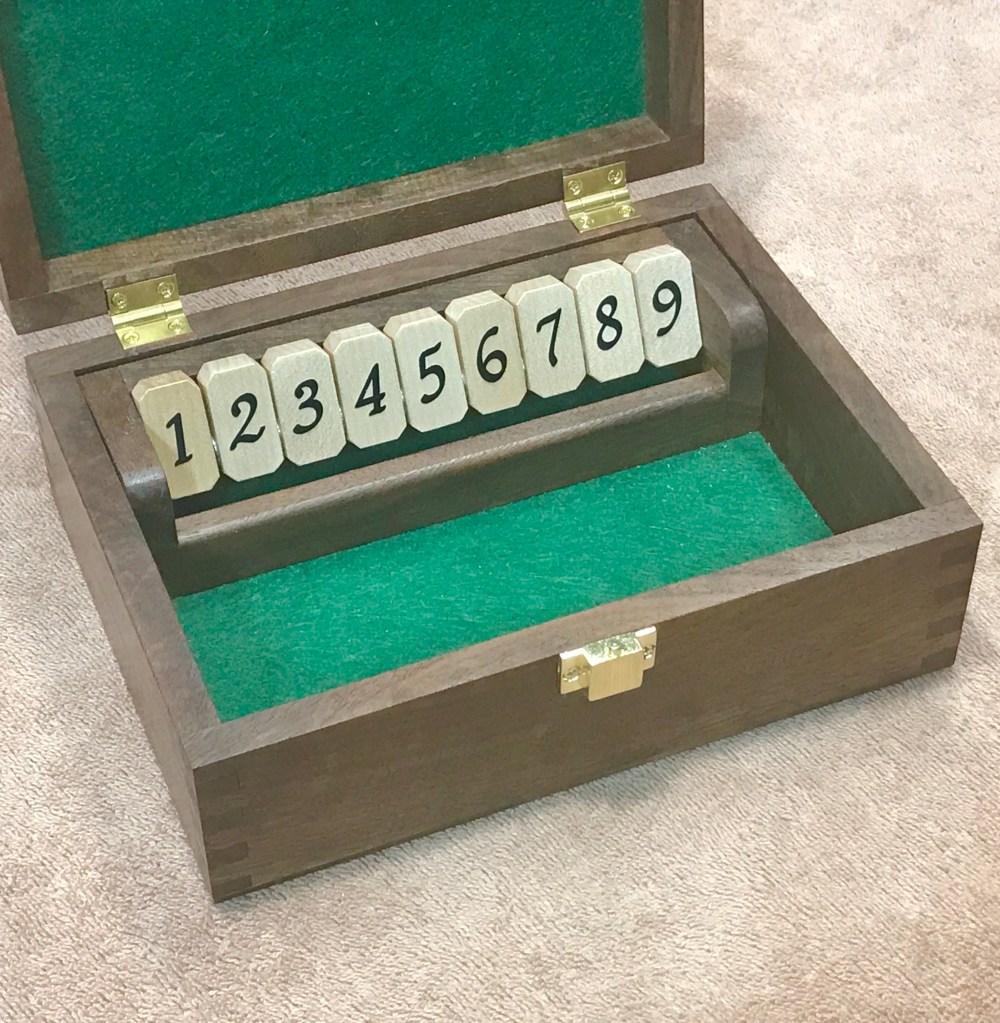
Walking distance from my house, there’s an English-style pub that I frequent. Along with a quiet ambiance, they serve cask ales. Good ones. As part of that ambiance, the pub has a bookshelf stocked with quite a few games, as well as books of course. One of the games drew my attention – not because I wanted to play it but because the box was interesting. Shut the Box is a simple dice game not too unlike Yahtzee. Roll a pair of dice and using the results see if you can eliminate numbers in the form of tiles, 1 through 9. Probably gets more interesting as you consume those cask ales. My interest was in the possibility of reproducing the game in my woodshop. That in mind, with the next visit to the pub I brought along a ruler and recorded all the relevant dimensions. My thought was to replicate the design fairly closely. Here’s the original from the pub:

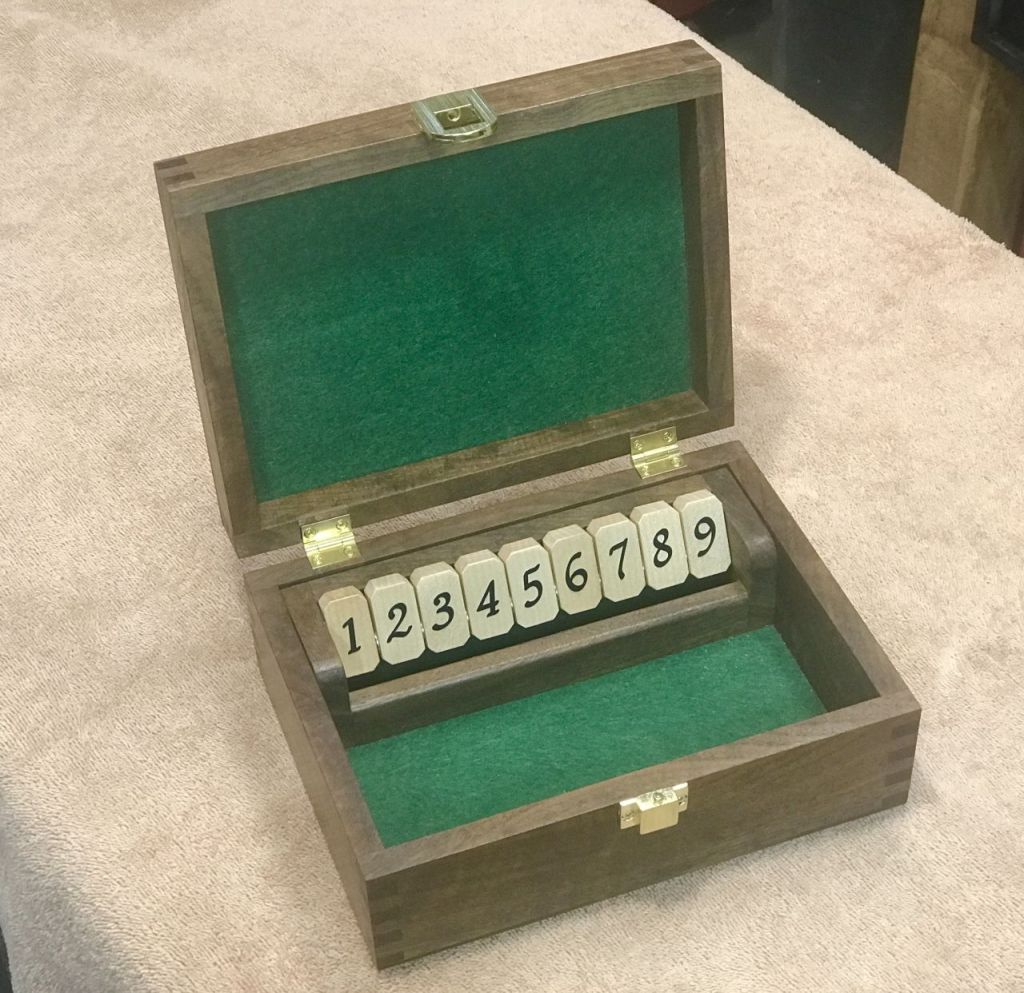
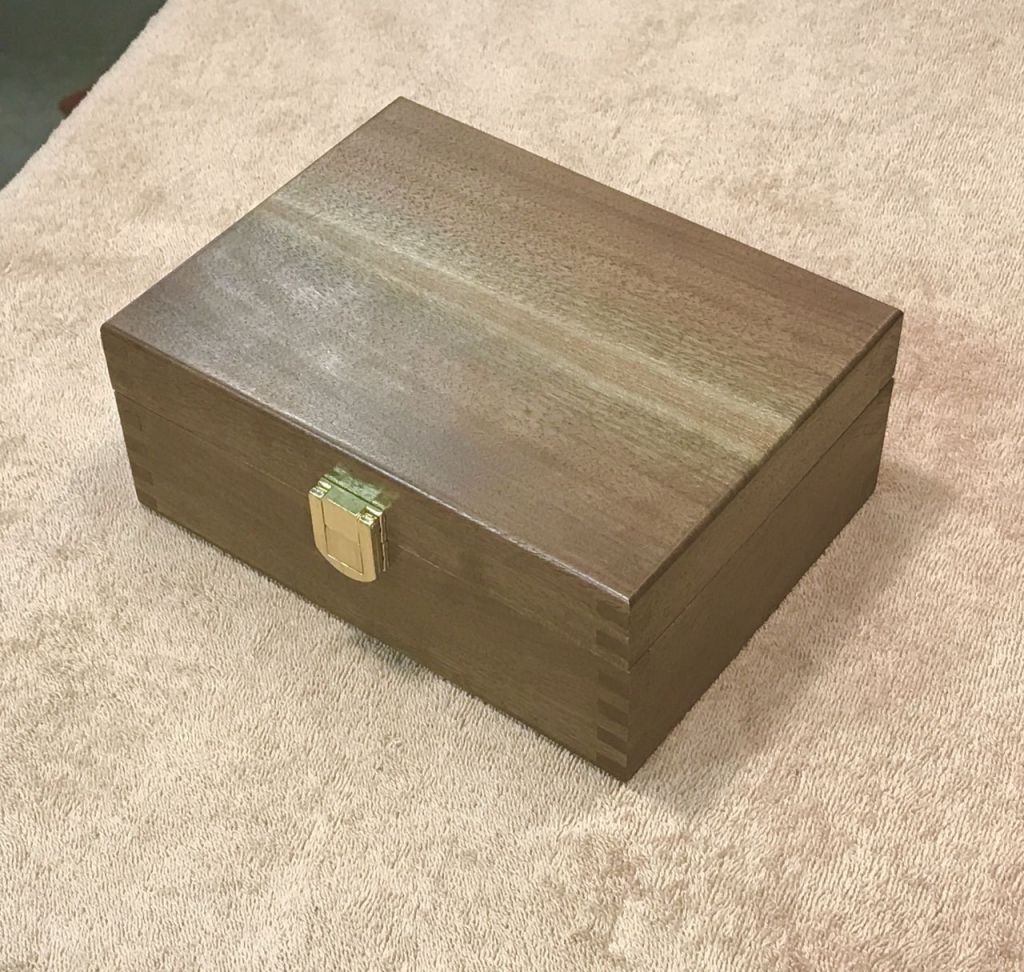
And here’s mine:

Mine is slightly bigger than the pub’s version, and as you can see, I decided not to attach a carrying handle. I have no idea what species of wood the original is made from but mine is walnut with alder number tiles.

In theory, this shouldn’t be a challenging project. In practice, it turned out to be just that. Walnut is a hard, somewhat brittle wood so I knew I’d have to be careful to avoid chipouts and such. The top and bottom pieces were joined using my Rockler box joint jig, which I’ve used before and now have some practice with. The larger bottom piece went OK but the top, not so much, due to failures in skill (me), failures in design and failures in equipment.

First step was to mill half-inch thick pieces from the raw walnut stock I have on hand using the table saw and thickness planer. This wood came from a downed tree in Decatur, Georgia near where I lived at the time. The property owner invited neighbors to come grab whatever scraps they wanted after the big pieces were professionally cut and hauled off. I got quite a few chunks and this is the second project using that wood.

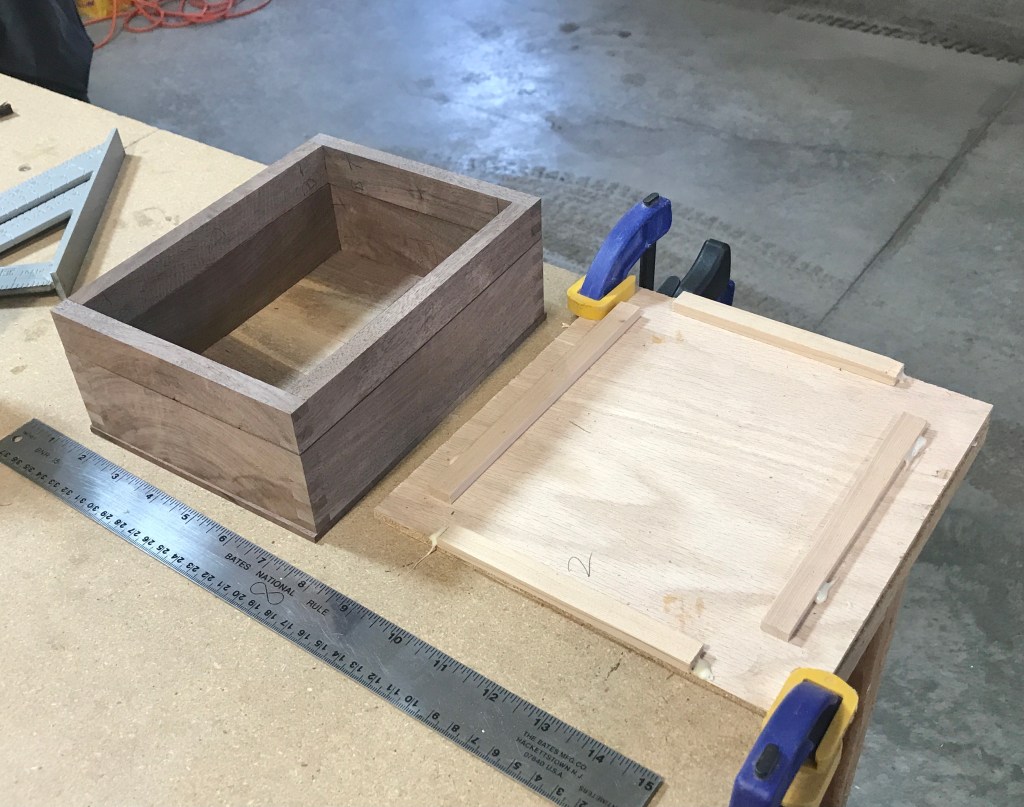
Bottom piece:

The box joints were tight, the fingers protruded the right amount and the glue-up went smoothly. Yay! On to the top. And on to three failures.

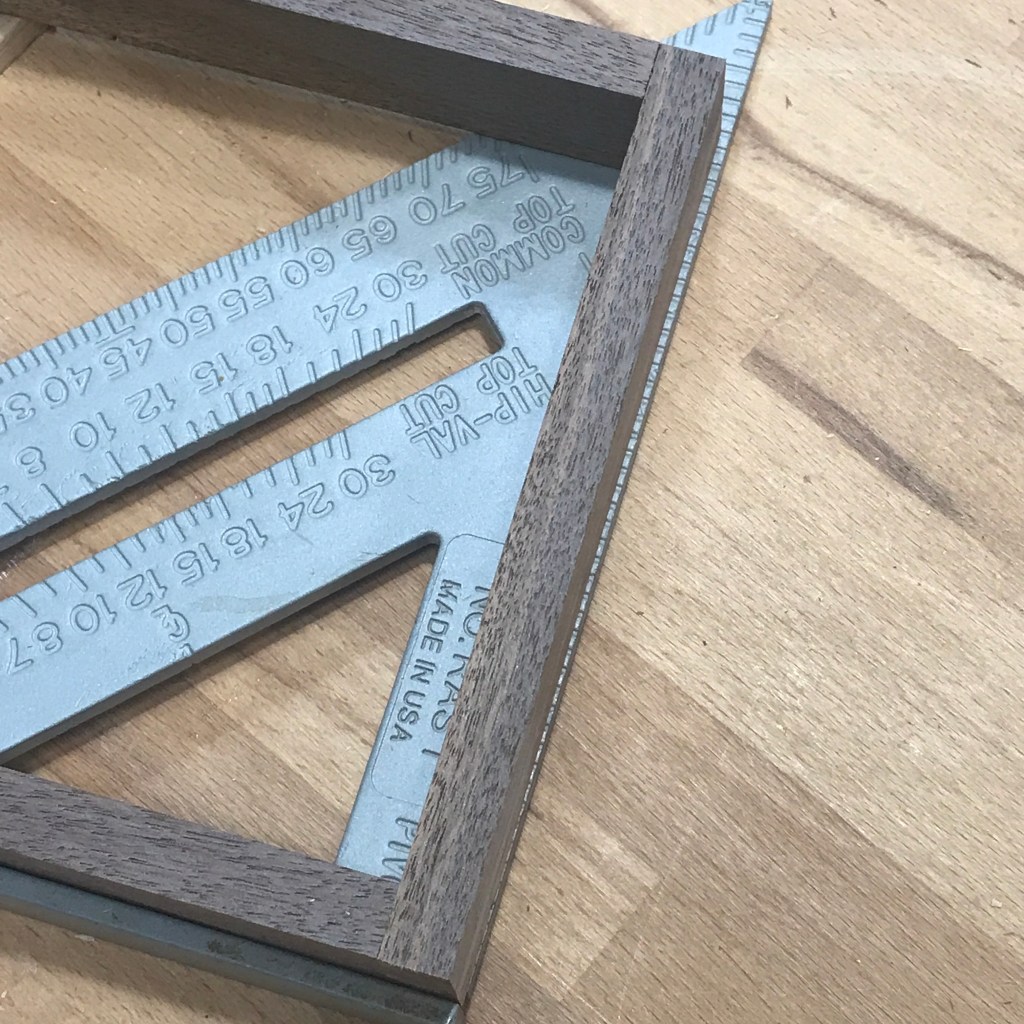
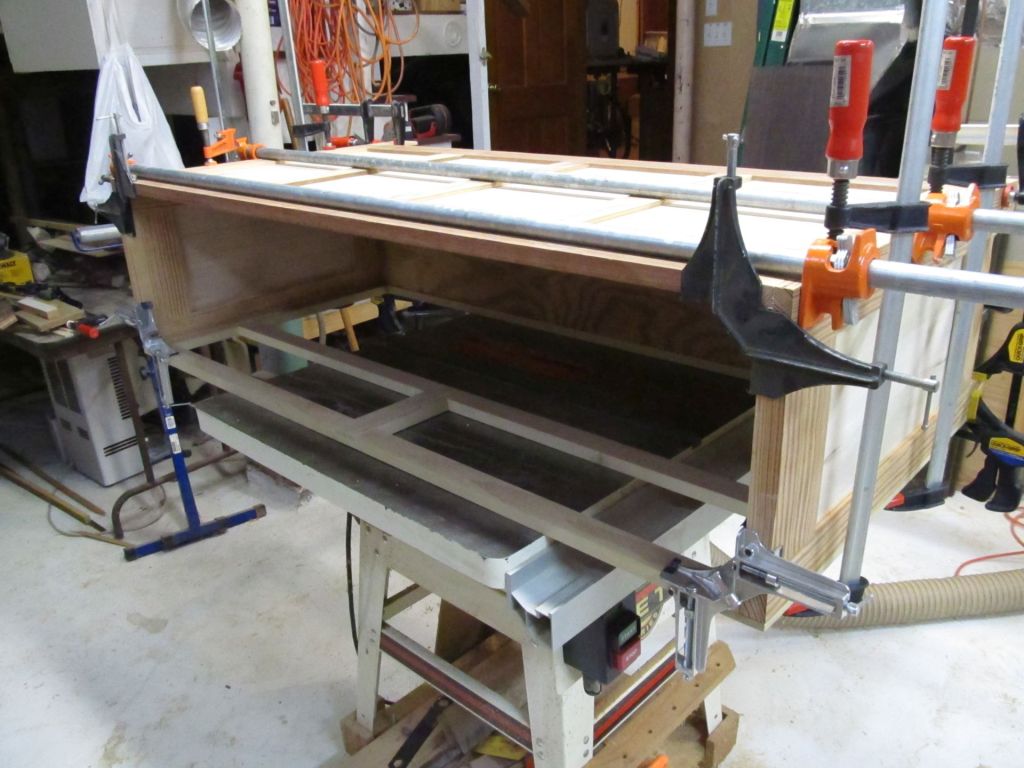
First failure (skill). As you can see in the photo above, I did the bottom glue-up using corner clamps. They work well but you still have to be careful. I apparently wasn’t with the top piece and it set up out-of-square. Boo.

So, back to the stock to make four new sections for the top. Fortunately, the router table and box joint jig were undisturbed from the first run. If that had not been the case, because the router bit height is crucial to the final overall size of the box, I would have to spend a lot more time and care getting it right so the top dimensions would exactly match those of the bottom. Hold that thought.
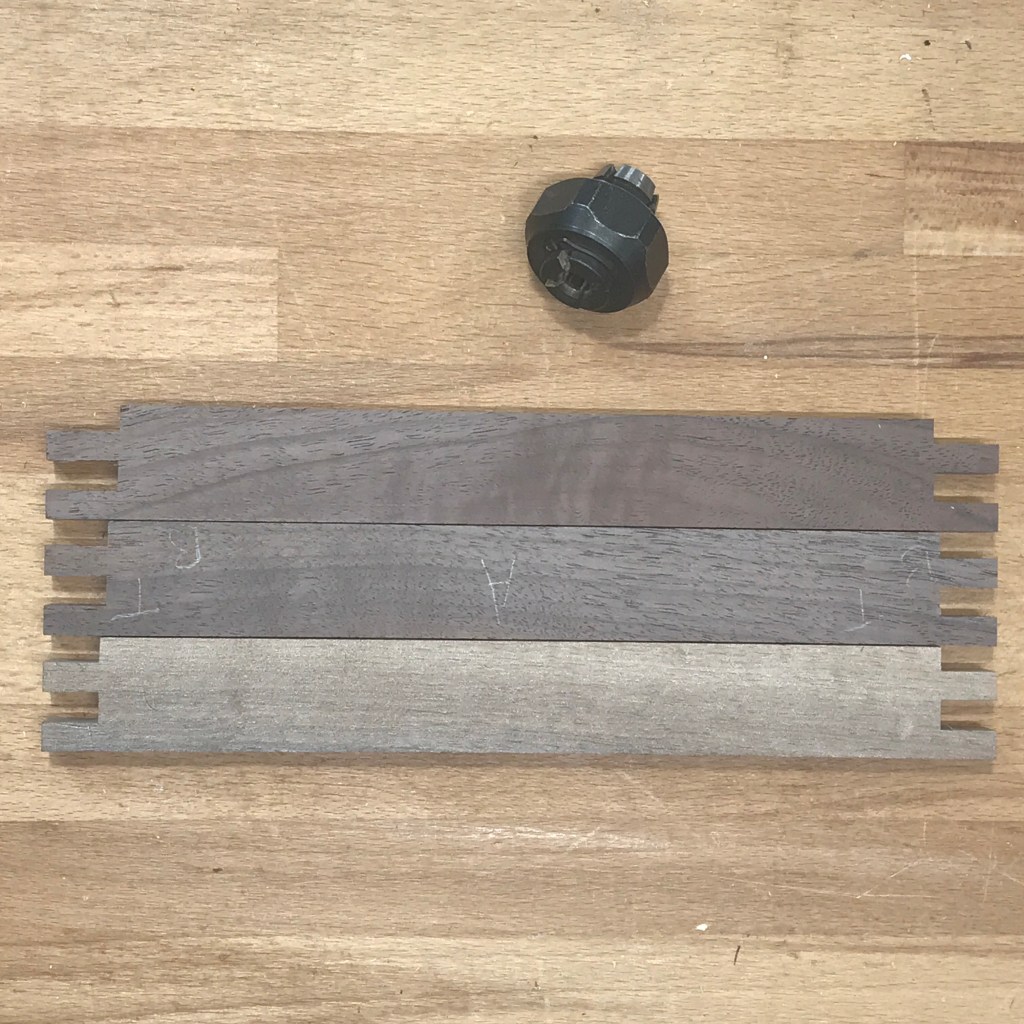
Second failures (equipment). The second attempt at the top piece was a bigger disaster than the first. Without my noticing it at first, while running the wood through the router bit in the box jig, the bit actually slipped in the collett (the part of the router that grips the bit) causing the depth of the cut to increase. In the next photo, I’ve lined up three pieces and you can see the length of the box joint fingers increases from bottom to top. The offending collett is shown too.

Back to the wood stock to get three new pieces (the first piece above actually is correct – the collett began slipping on the second). That thought I asked you to hold onto? Well, here we are. Because I had to reset the router bit (tightening down firmly) and the box joint jig, I had to do the tedious process of adjusting, testing, adjusting more, testing again until the bit was cutting exactly the right amount as with the bottom piece. After doing that, I ran them through the router and jig. AND IT HAPPENED AGAIN! Gah. The bit slipped in the collett. Again.
At this point, three thoughts passed through my mind. First, give up and go back to making air purification units (see previous blog post). Second, I’m running out of walnut and can’t afford another disaster like this. Third, why did this happen? I tightened the collett pretty firmly. After dismissing the first thought and keeping the second in mind, I had to get an answer to the third. Yay internet. Turns out that colletts can actually wear out and lose their gripping power. Who knew? Not me, obviously. So I ordered a new collett and put the project on hold until it arrived.

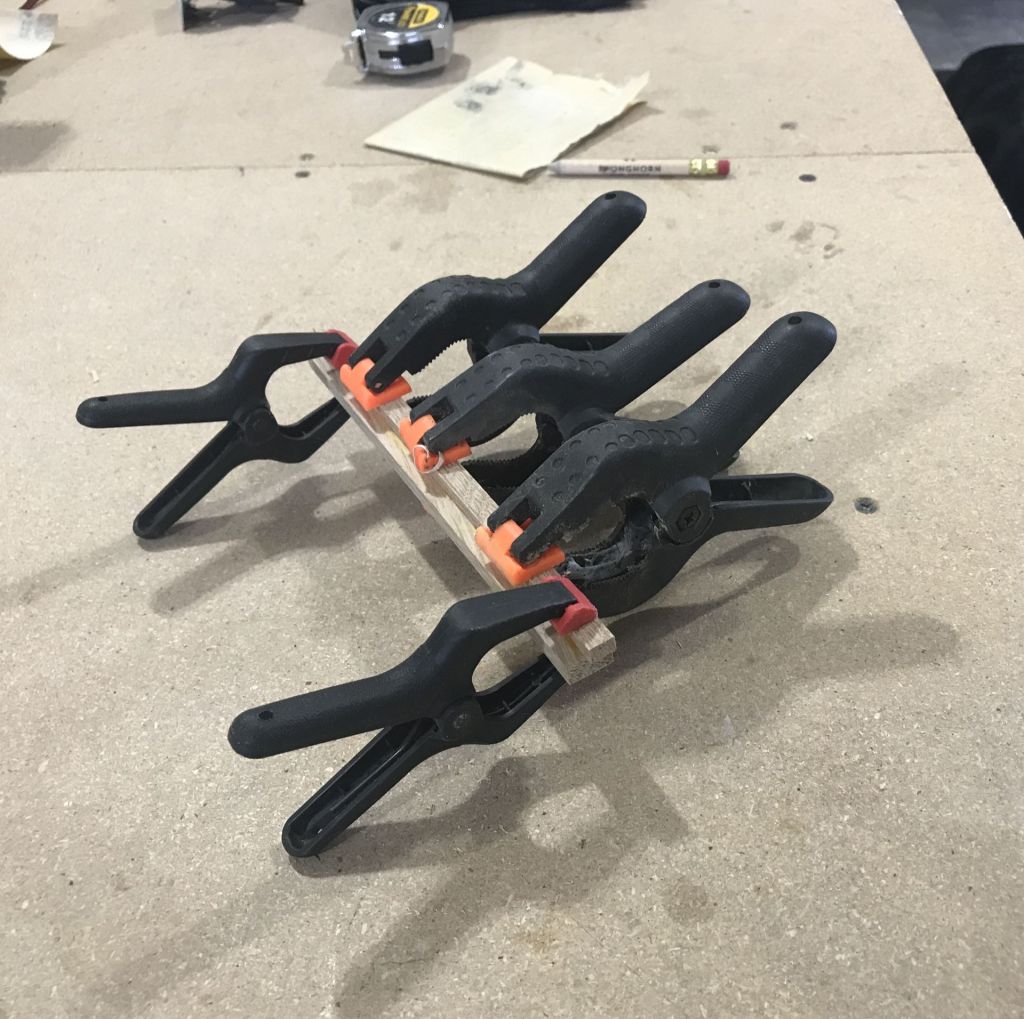
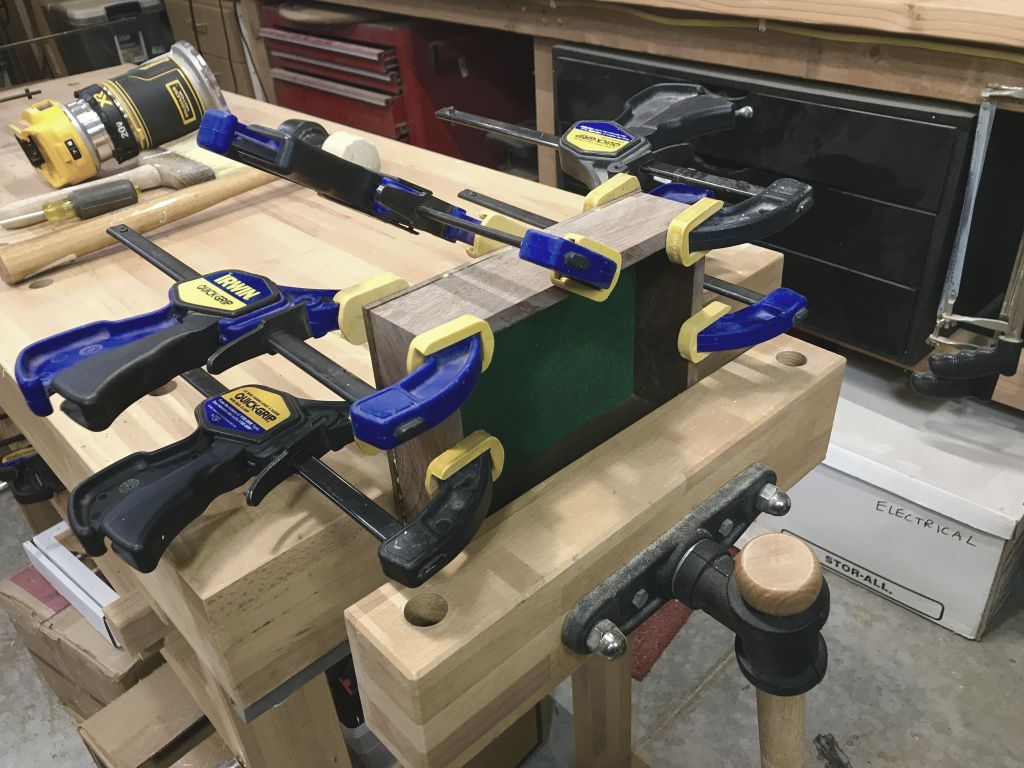
Resuming work with the new collett (I ordered both a 1/4 inch and 1/2 inch), I repeated the process of router bit and jig setup and managed to end up with four good sections for the top piece. This time, instead of relying on my corner clamps, I made a simple jig to hold the thing square while the glue set. Worked fine and I now had both the top and bottom pieces mostly done. Still needed a lid and a base. The two photos show the base already made and the initial sanding to get rid of the protruding joint fingers (I used a sanding disk installed in the table saw). I didn’t take any photos while making the base and lid – nothing disastrous occurred in that process despite having to edge-glue two fairly thin pieces of walnut to make each.

At this point, the box is mostly done. Still have to install the lid and base, install felt, install hinges and make the inside bits. Gluing the lid & base and installing felt was straightforward.

Next up was hinges. My first plan was to use side-rail hinges because they look cool and I already had them on hand. Unfortunately, that didn’t work out. Initially, I wanted to cut the hinge mortises using my Dewalt compact router and the hinge mortise jig I bought from Rockler. But I couldn’t find a guide bushing that would work with that router. Inquiries online informed me that that was a design flaw with the Dewalt. OK. Next plan was to use the router table and fence which would have worked well except for:

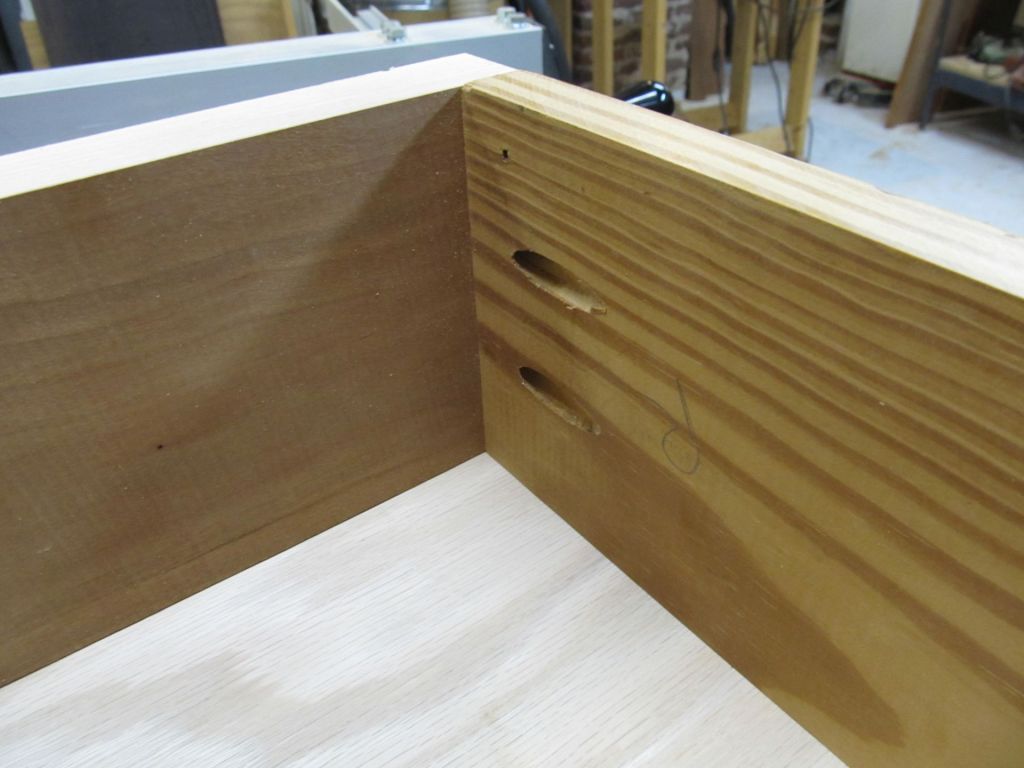
Third failure (design). Using one of the now many pieces of discarded top pieces, I attempted to practice cutting a hinge mortise and discovered that I had not thought out that design well enough. The mortise would need to cut across a very thin finger along the back edge of the bottom piece. Walnut being brittle, the wood chipped. The design should have accounted for having a finger at the top of the bottom side piece running all the way to the back. See photo. Unfortunately that really wasn’t something I could recover from and still use side-rail hinges. I had to go with box hinges set into the back edge. That was a disappointment because I liked the look of the side-rail hinges. Photos shows the box hinges and the little pieces I glued into the hinge mortises to get the hinge placement precise. With hinges, it’s imperative to get them correct or the top and bottom of the box won’t line up and it will be obvious. I managed to get it right.

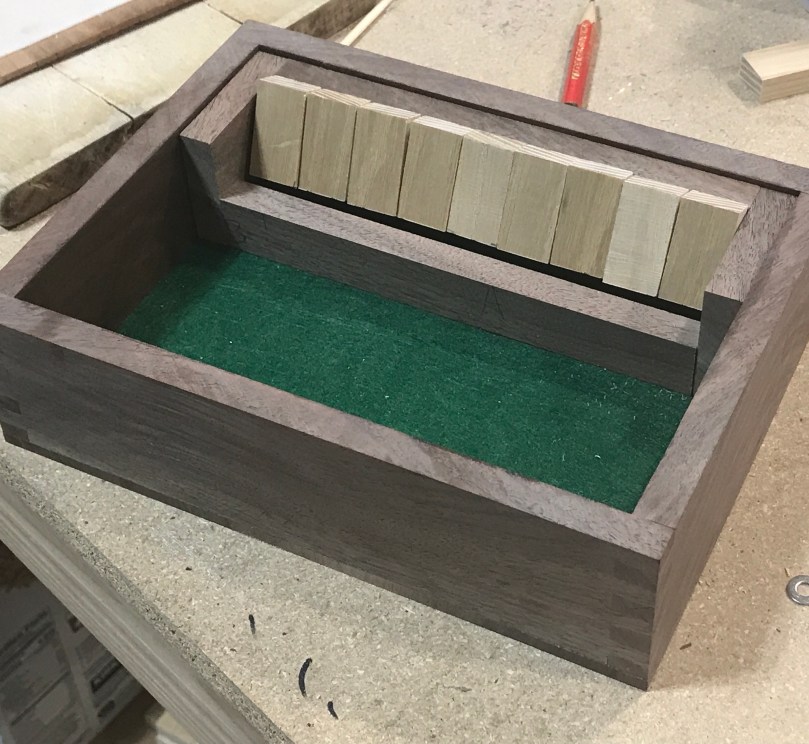
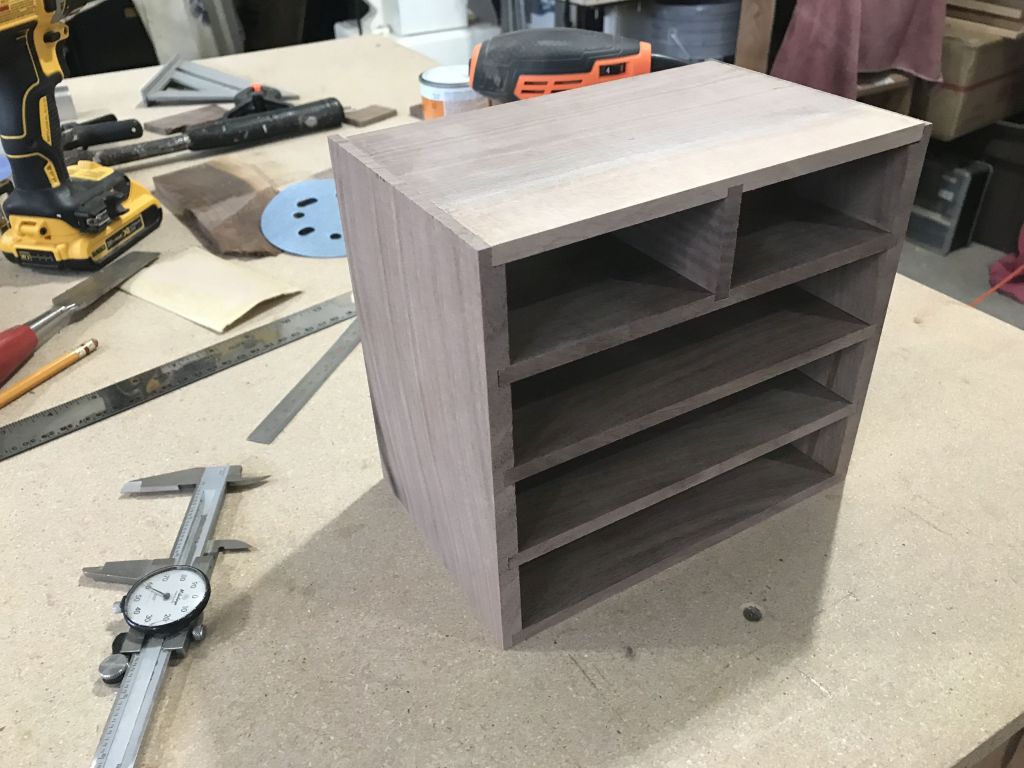
Next, the insides. The number tiles are held by a rod in a rack such that they flip down easily and lay on the front rail. Making the rack was routine. The original piece had a design on the back of the tiles but I decided against anything like that. If I had a CNC machine I might have done something. There were two attempts at making tiles. Initially, I tried making them out of white oak but the intense grain of oak deflected the drill bit enough such that the tiles didn’t line up evenly on the rod. It looked bad (see first photo). To correct that problem, I went with alder, a soft white wood which the drill bit cut through easily. After adding stick-on numbers and chamfering the tile corners, the end result looks good.

Finishing the box. Rounded all edges at the router table, then lots of sanding but still not enough to completely remove the mechanical sanding marks from the table saw disk. I’m really not good at finishing projects. After it was good enough for me, I applied several coats of wipe-on poly. I considered using something fancier like lacquer but the poly is easy, durable and makes the walnut look nice. Added a simple clasp and that’s it!

Despite all the failures and aggravation, it was a fun project and I’m pleased with the result. I’ll have to take it to the pub and try it out, after at least one pint of cask ale.

Next up in this series: Shove Ha’penny.

Four

This has been a tough year for family pets. Four now have passed on to their reward.

In January, we lost my buddy Chuck, who at sixteen went way too early. Chuck was almost like a dog – he’d come running to the door when I got home and even ran to the door when he heard me grab the keys to leave. A cat’s cat, Chuck lived like he was King of the World, getting into everything, racing around maniacally. Always around us, with us. He loved head butts, double-ear pets and basically any attention we gave him. Chuck was often in the woodshop with me, inspecting my progress. Just short of fourteen he was diagnosed with cancer. Not willing to let him go just yet, Chuck endured a year of chemo, which was as successful as we could hope – he got a year and a half cancer-free before the disease came back. Fuck cancer. I miss that cat.

Not long after, my sister lost Lorenzo, as sweet a cat as you could meet. L was elderly but still left too soon. That would be a theme this year. A laid back kitty, Lorenzo had years earlier lost his long-time buddy Kona but was joined by a rambunctious kitten, Agnes. Those two got along famously as well (See photo below – Lorenzo on the right.). The loss of Lorenzo drove a hole in my sister’s heart and left her house with an empty feel that Agnes, great kitty that she is, could not quite fill.

Spring and summer came and went. My sister adopted an adorable Norwegian Forest cat, Abby. It seemed then that the pet drama for remainder of the year was getting Abby to coexist with Agnes, a kitty undoubtedly affected by the loss of her best friend Lorenzo and maybe wasn’t ready for a new roommate.

But no. I mean yes, that drama played out but it was shortly overshadowed by the passing of our Koda, aka The Mutt. Koda was The. Best. Dog. Ever. (Apologies to Spot.) Her life was also way too short and way too full of medical issues. Koda came to us as a shelter dog in very poor condition. We instantly saw she was the one and proceeded to fix her up best we could. Koda was a Kelpie and like the breed, she loved the outdoors and liked to ‘herd’ us as we hiked the many trails of Central Oregon. Like Chuck, Koda often hung out with me in the woodshop, getting in the way mostly. Her medical issues never completely went away and last year she developed severe seizures, horrifying to watch as there was nothing we could do other than make sure she didn’t hurt herself. The pet neurologist prescribed an anti-seizure medication which worked fabulously in terms of stopping the seizures but also severely affected her mind. Koda essentially became like an Alzheimers patient, a condition which degraded in the coming months. In late October, her condition plummeted and it was time to let her go. She was maybe fourteen years old. We miss that pup immensely.

You might think that was enough, that 2022 was done inflicting pet trauma. Sadly, no. Unexpectedly, that sweet new girl Abby developed symptoms of compound medical problems, issues too great to overcome. To say she left too soon is a tragedy of understatement. Although Abby wasn’t with my sister very long, they almost instantly developed a close bond. I was lucky enough to meet Abby during a two-week trip to visit in early October, in time to witness the Abby-Agnes drama but before Abby’s medical issues cropped up. Unfortunately, I had to cut that visit short to rush home to be with Koda in her last days. We were all very much looking forward to the time when Agnes finally accepted Abby. The signs were there that it would happen.

Four pets. Four fur friends. Four chunks of our hearts. Gone. Remaining are Andy, our cat and the eldest of the bunch at over eighteen (Lorenzo might have been a bit older, we’re not sure), Agnes, still in her prime, and my other sister’s cat Frankie, also doing really well. We all started the year with six pets, added one and now have just three.

Slide-top Box Redux

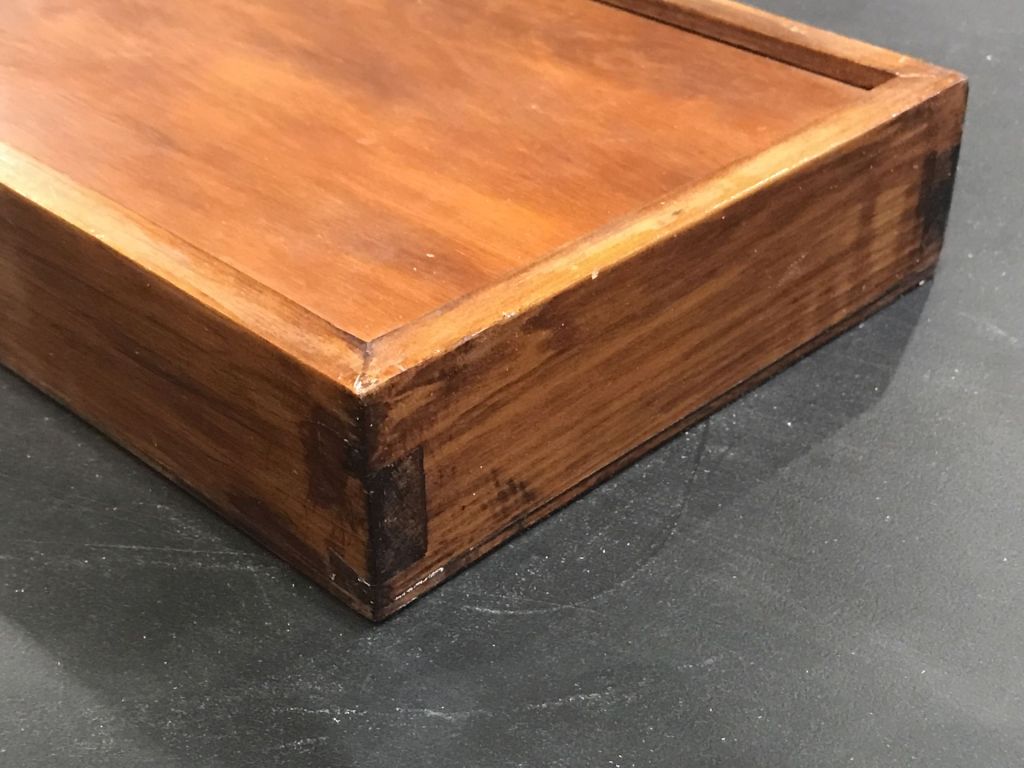
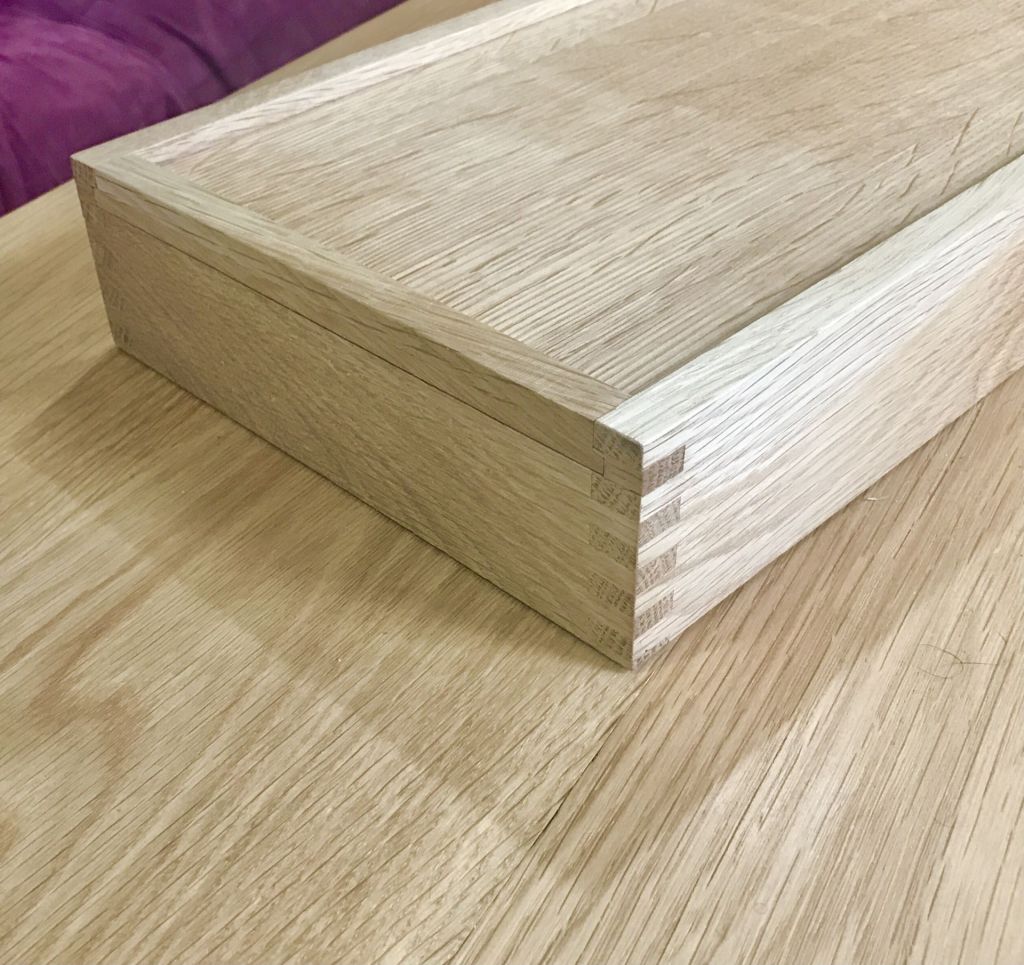
Although I still can’t claim much expertise even now, I can call myself a long-time woodworker. Over fifty years, in fact. While casting my eye about looking for a new project, I saw something I’ve had since my high school days in Queensland, Australia: a slide-top box made in woodshop class using hand tools, mostly. It’s not much to look at and the dovetails are really crude, but it’s lasted fifty years and the top still slides open nicely.

My thought was – why not duplicate it except not with dovetails? I suck at dovetails and even donated my jig to the local DIY place. I’ve been looking for an excuse to use my box joint jig and this seems like the ticket.

Having no clue what wood species the original was made from, I decided to just use white oak because I not only had some pieces left over from one of the air filter projects, I also had leftover white oak veneer.

I’ll jump ahead and post the final results. Finish is a wipe-on poly, lightly applied.

I was a little worried how the oak would do in the box joint jig, anticipating some chipout but it did quite nicely. Helps to have sharp router bits. The jig being a newish addition to my tool inventory, I was somewhat unfamiliar with it. Lessons would be learned. The first lesson involved the highly recommended step of setting up the jig using test pieces. I did that with some scrap hemlock but I sort of ignored the part about the test pieces needing to be the exact same width. Mine were close but not exact. Well, close only counts in horseshoes and hand grenades, as they say. I had to repeat the test setup using correctly sized test pieces. I did gain some experience with the jig however and the small box I made with hemlock was nice enough that I made a trinket box out of it.

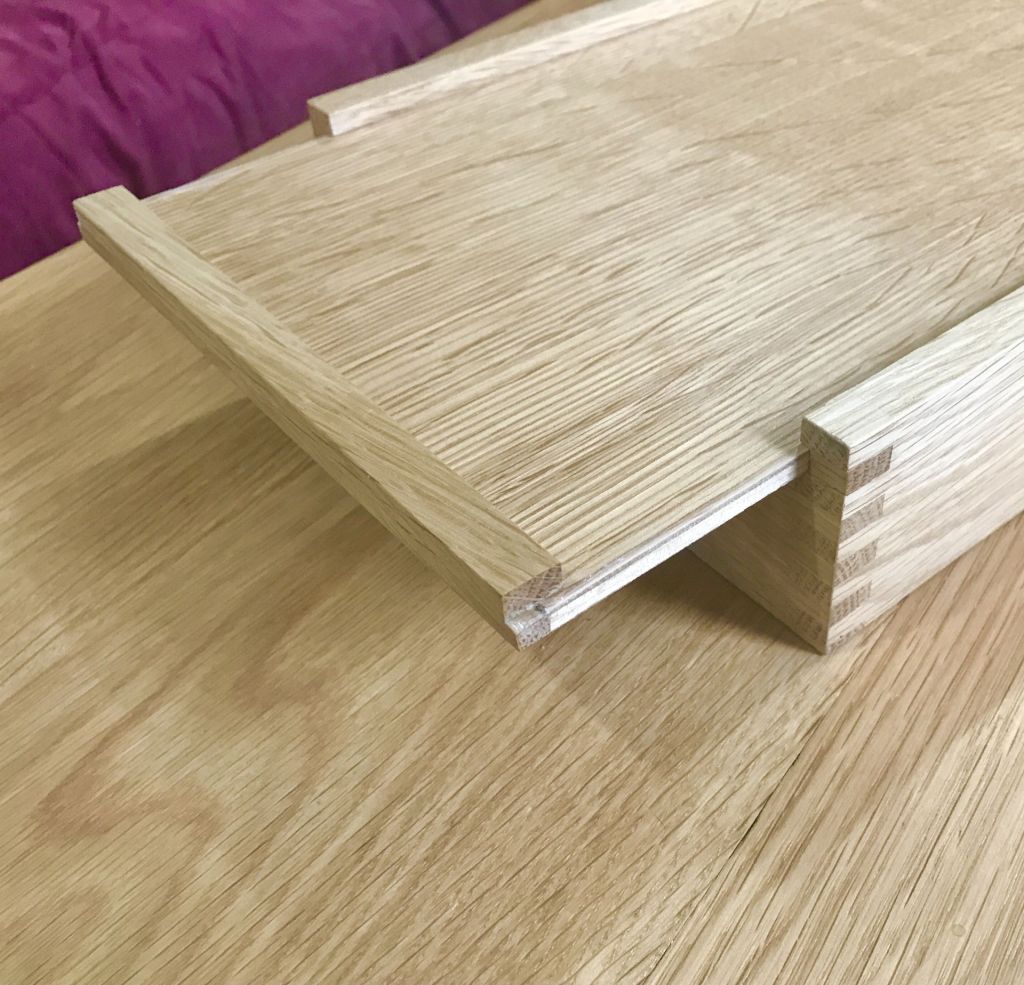
Results with the white oak – very clean fingers.

After some routing and dadoing, check for square and glue up:

After applying the veneer to the 1/8″ plywood top, I needed to fashion the end piece.

Had to fill in a couple of spaces with scrap oak. I probably could have designed it not have to do this but, as is my practice, I was winging it.

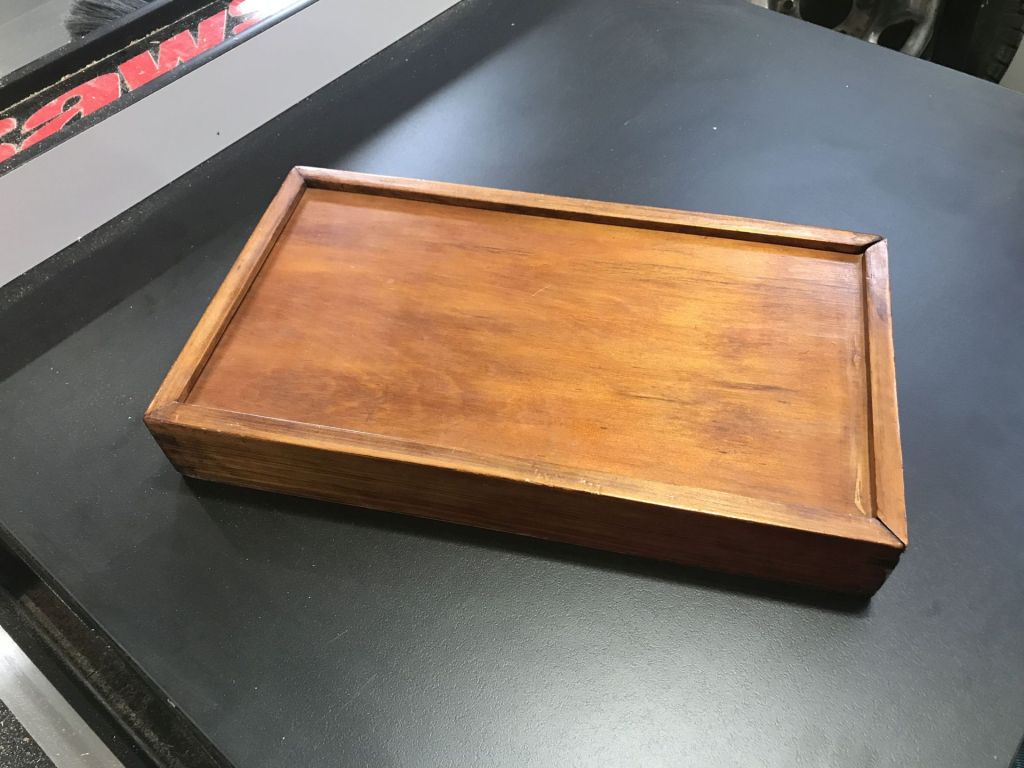
The only things remaining were to attach the bottom and apply the finish. One improvement I made from the original was to rabbet the bottom edges to accept and hide the plywood bottom. The original did not do that, so you can see the bottom from the sides. I also did not exactly match the overall dimensions as you can see (photo before I applied finish). The new is about the same width, a little taller and significantly shorter in length:

This was a fun project both from the standpoint of doing box joints and because it recapitulates an object that represents one of my earliest memories.

Air Filtration Unit #4

Last summer, Central Oregon – along with a large swath of the western US – experienced yet another season of raging wildfires. And with wildfire comes smoke, lots of it. It got pretty severe in here in Bend, very unhealthy. In recent years, I’ve combated the problem by making air filtration units equipped with near-HEPA filters and ultra-quiet fans. So far, I’d made three such units. Along with the house forced air unit (the furnace), we kept the inside smoke to a minimum. My next door neighbor also suffered from the smoke so when the air was at peak unhealthiness, I quickly cobbled together a portable air filter to help out. It was basically just a wooden frame sized to fit a filter and then attached to a fan. It worked but was obviously a temporary solution.

After the smoke cleared, I took the filter/fan unit back and proceeded to construct a proper one. My initial thought was to make it into a bedroom end table but the space and dimensions weren’t right so option B was to see how small a piece of furniture I could squeeze the fan and filter into and go from there.

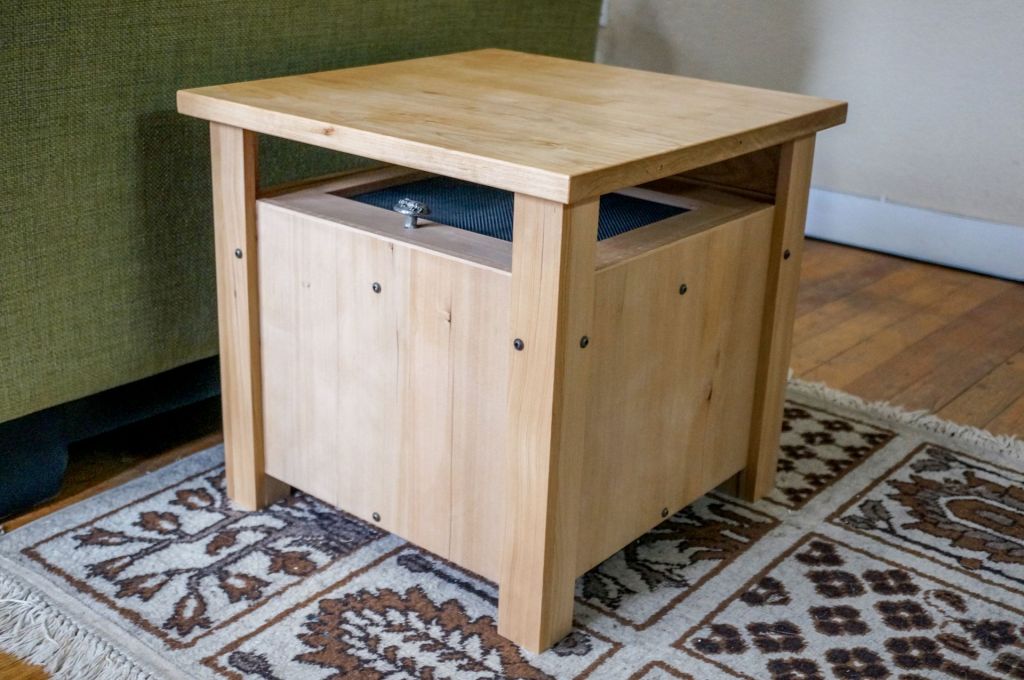
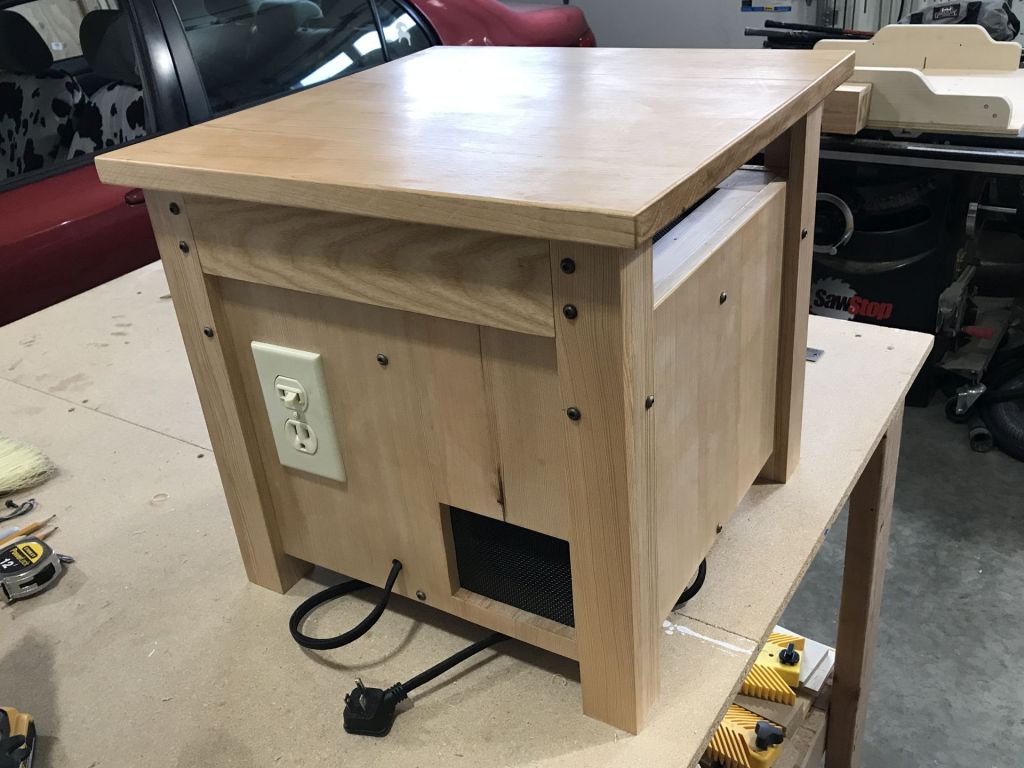
Here’s the result:

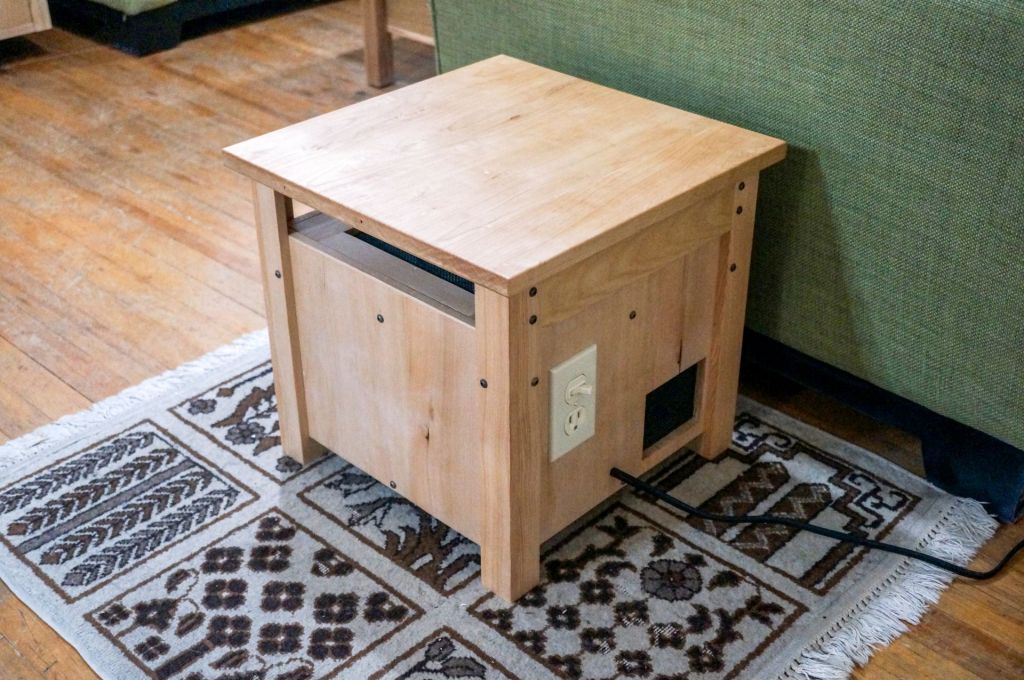
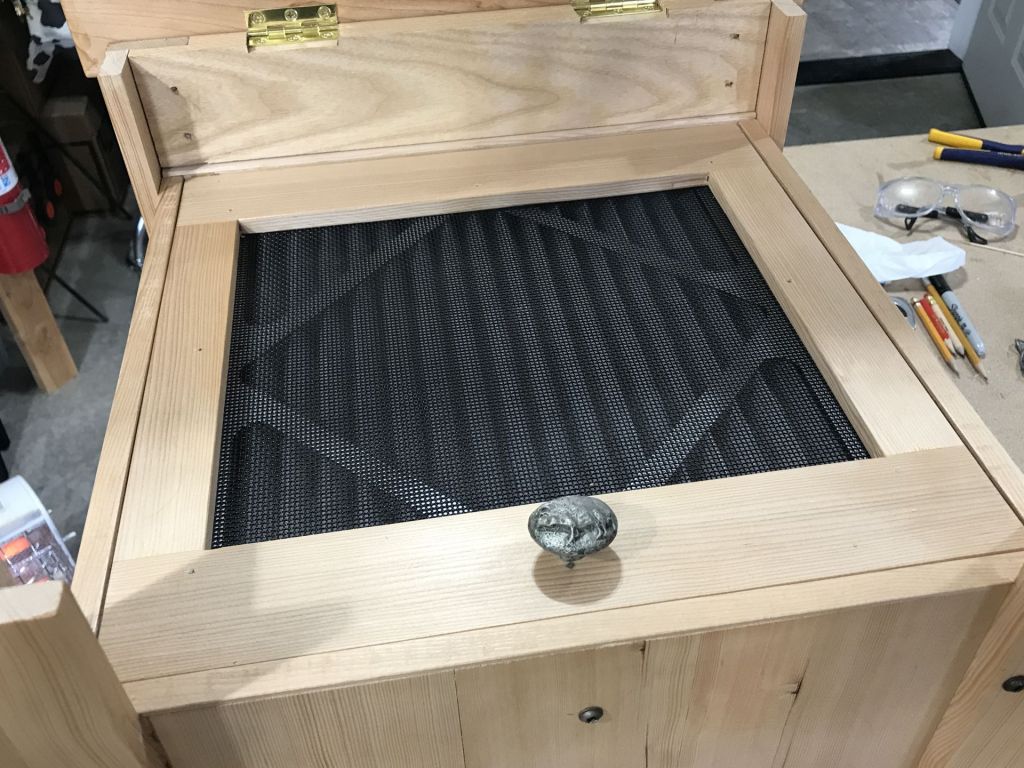
It’s almost exactly a sixteen inch cube, with the body and legs made from hemlock and a flip-up top from alder. There’s a 12″x12″x1″ filter that sits inside held by gravity. A wood frame with a screen sits on top of the filter. It serves no function other than to hide the filter from view. As with the last two units, the electrics include an outlet in case you want to set a lamp on top, or a phone charger, or whatever. Air is drawn in through the gap on three sides and exhausted out a port in the back. The gap on the fourth side is blocked with a piece of hard white oak, necessary to attach hinges.

I’m happy with the result but, like with all my projects that I build without a set design (winging it), I made mistakes – some I had to correct, some I decided to live with. I’ll mention those in the build details.

Sizing things up:

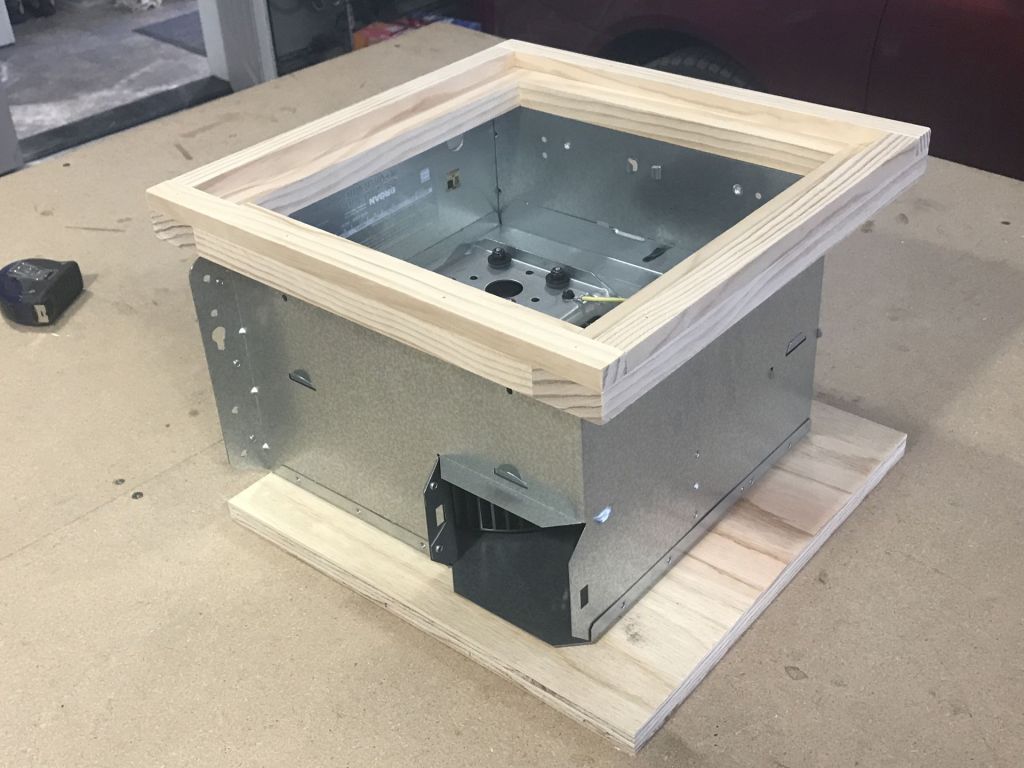
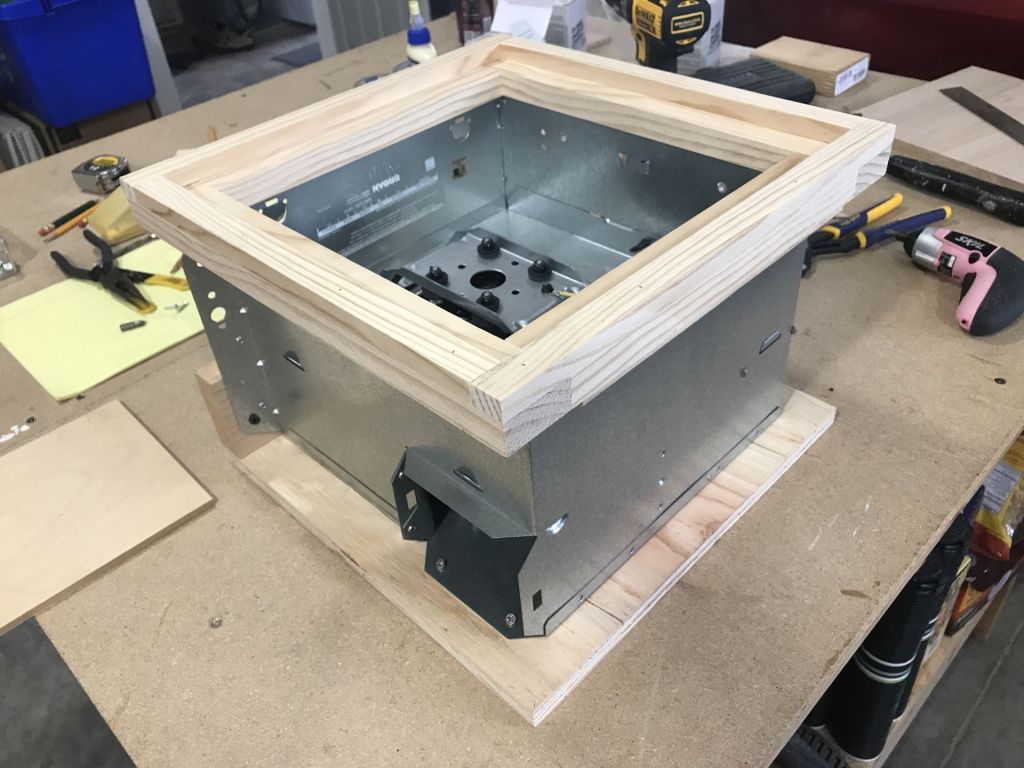
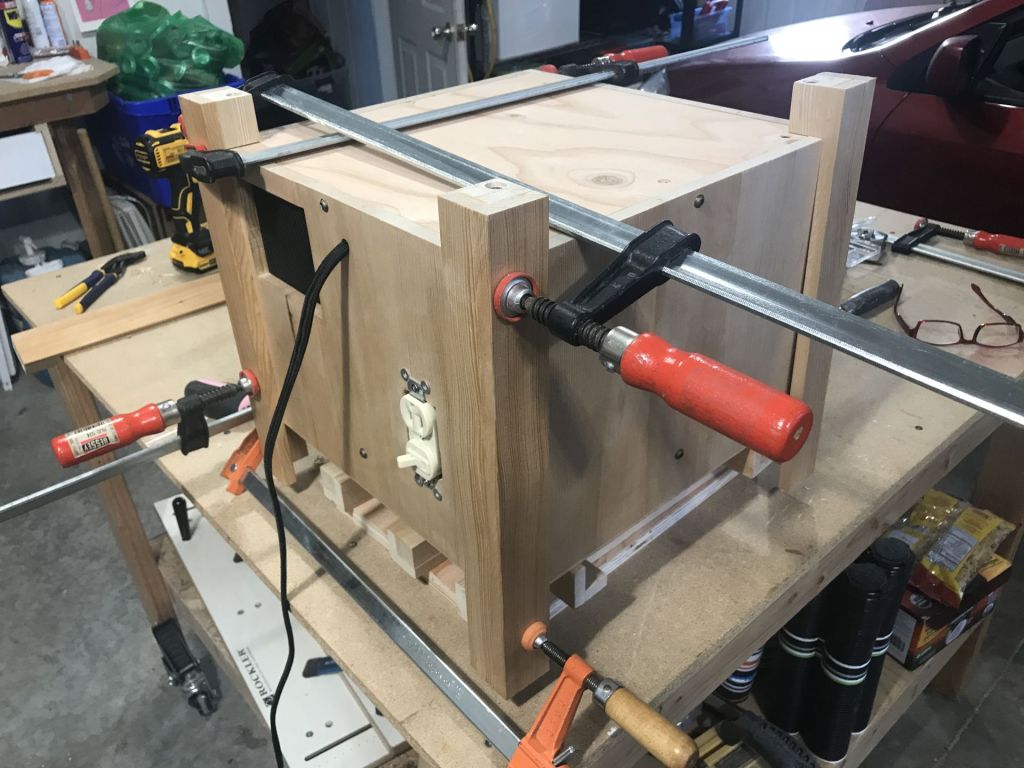
I started with the wood frame piece I built for the temporary unit, seen here sitting unattached on top of the fan (a Broan bathroom fan). It was sized to hold the filter so there was no reason not to re-use it. The plywood on the bottom was cut to the same size as the filter frame with the idea I could ‘simply’ slap four side walls around the fan. Mounting the fan to the plywood and the frame to the fan seemed trivial but actually was quite a finicky operation given that the frame had to be lined up exactly with the bottom.

This is the result (above). I first attached a piece of 2×4 to the bottom to provide a secure mounting surface for the fan’s side flanges, and also screwed it to the bottom directly. The filter frame is then attached to the flanges on the fan body – the finicky operation that required keeping the frame exactly lined up while I drove screws in from the bottom. It took like an hour to do that.

The sides:

Unlike with the living room end-table piece I made a couple years ago, for which I used nice white oak pieces, I was looking at lighter, cheaper wood for this unit, preferably available from the local big box hardware store. My choices were poplar and hemlock. I’d not made anything with hemlock before and I saw the store had 1/2″ stock available in that species, so hemlock it was. The thinner stock would cut down on weight and wouldn’t require me to plane 3/4″ pieces down to size. And hemlock is fairly cheap.

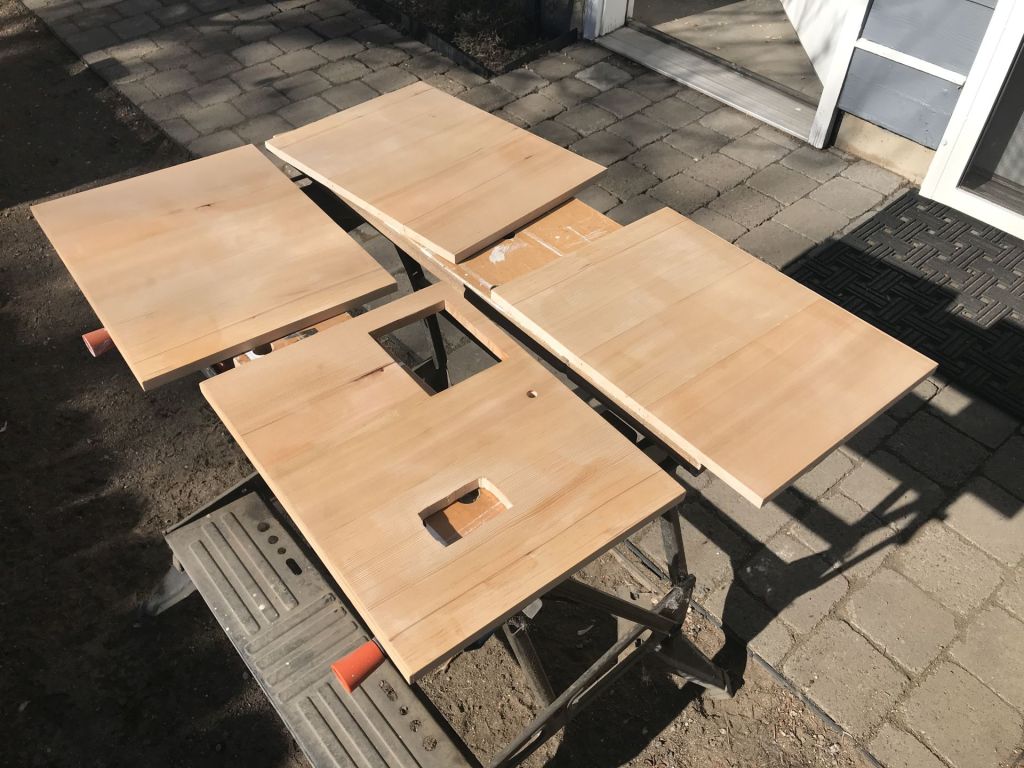
The easiest way to fashion the sides was to glue three long boards together using a spline joint and then cut the individual sides to size.

One side needed a bit more work to accommodate the exhaust port and power switch/outlet. And it’s here I made my first mistake, which I didn’t recognize until much later in the build. I think the exhaust port should have been on a panel adjacent to the power switch. That way the unit can sit against a wall hiding the switch and cord, while the air is free to flow out the side into the room. As it is, the unit will have to sit away from the wall to ensure proper air circulation or the switch and cord will have to be visible. Not a huge issue.

To hide the end grain at the top of the side pieces, I glued a thin slat of hemlock. Then a round of sanding and a couple of coats of wipe-on poly.

Electrics:

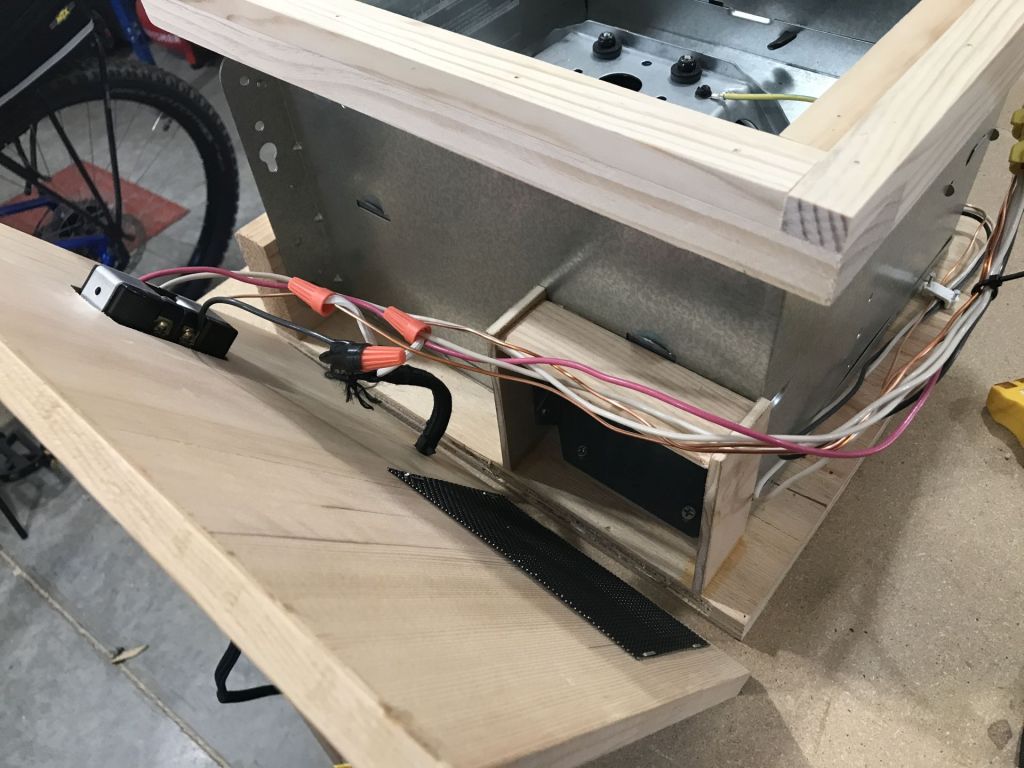
Before attaching the sides, I installed the switch/outlet, ran the wiring and also fashioned a short duct to channel the fan exhaust to the outlet port. There’s a screen over the port to keep critters out.

Legs:

Also made from hemlock, the legs are two pieces glued in an ‘L’ shape designed to ‘capture’ the side pieces against the plywood and filter frame. Besides being lightweight, the design accommodates my goal of being able to disassemble the unit in case the fan malfunctions or the outlet fries. For additional support, I glued blocks inside the legs; the body of the unit actually sits on these blocks with long screws coming up from the bottom. Before attaching the legs, I put screws through the middle of the side panels, top and bottom. The screws are a nice-looking square drive type I found at Lowes.

We arrive at another of my mistakes; this one I had to correct. Originally, I sized the leg pieces to overlap the sides by maybe an inch. That wasn’t enough as it would mean driving the screws too close to the edge of the wood. I had to trash them and start over using wider pieces.

Here’s where we are with sides and legs attached and wiring complete:

The top:

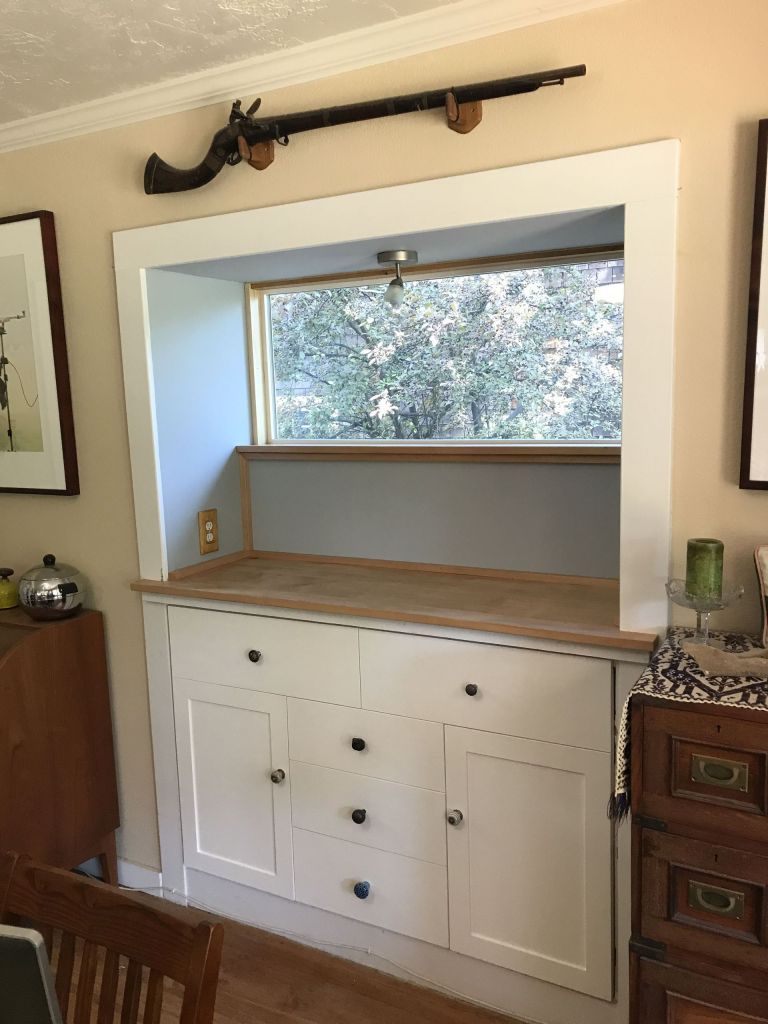
For the top, I judged hemlock to be too soft. I wanted wood that would be at least a little impervious to scratches and dents, but not heavy white oak. A couple of years ago, I rebuilt the bay window shelves in my dining room and used alder for the top. Alder is also sort of soft but not like hemlock. It’s also a light-colored wood. So, off to the local wood supply store to fetch some alder.

A gratuitous shot of the bay window build:

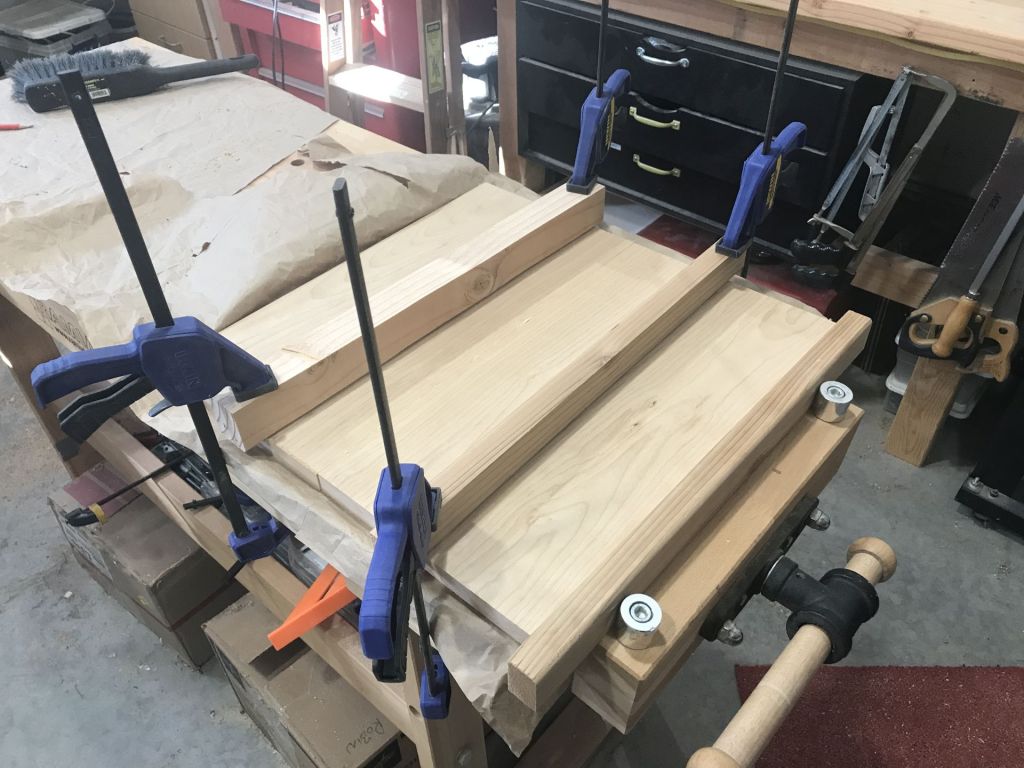
I used a familiar method to join pieces to make a wider panel: biscuits. I like my biscuit joiner, although it’s probably not the choice for more accomplished woodworkers. And here I made another mistake. Not having decided on exactly how big the top would be – that is, how much it would overhang the sides – I glued up a big enough piece thinking I’d just cut it down to size. But I didn’t think about where those pesky biscuits were and ended up cutting through them on one side. It’s not an issue structurally but you can see the biscuits (that edge isn’t seen in the below photo but you can see it in the first two photos I posted).

The top is just a flip-up deal with hinges on one side. I needed a stout piece of wood to attach the hinges to so I inserted a piece of white oak on the back (what I’m calling the back – the side with the switch and outlet port).

You’ll also see in the above photo where I decided to glue blocks inside the part of the legs that stick up, thinking they would provide a nice surface to attach felt pads. I eventually removed them, which involved taking the legs off and running the table saw blade along the inside. It was that or toss them and make a (third) set of legs. The table saw did the job nicely.

Removing those upper blocks became necessary because of a design element. With the sides open to allow air in, the filter was visible and it didn’t look right. Initially, I tried to design side screens but it just didn’t work. The solution was to build a screen frame to sit on top of the filter and hide it. For added interest, I attached a cool pig knob to the screen.

So here’s the final unit:

The tale of the 4th air filtration unit is not complete without one more mistake. Not a mistake, per se, but a minor design issue. I was real proud of how the top came out – it was absolutely flat and sits on the legs perfectly. But over a couple of weeks, I noticed it was warping slightly. It still sits on the legs nicely but the front to back edges are a bit bowed now. It’s not real noticeable but might get worse. After contemplating ways to fix the issue – or at least halt further warping – I decided to leave it be. The top is not designed to be strong – you can’t sit or stand on it, so a bit of bowing is OK. Probably the reason it bows is because I failed to alternate the grain patterns of the three pieces I glued to make the top. Rookie error. Next time I’ll be sure to do that, and to incorporate some sort of strengthening pieces.

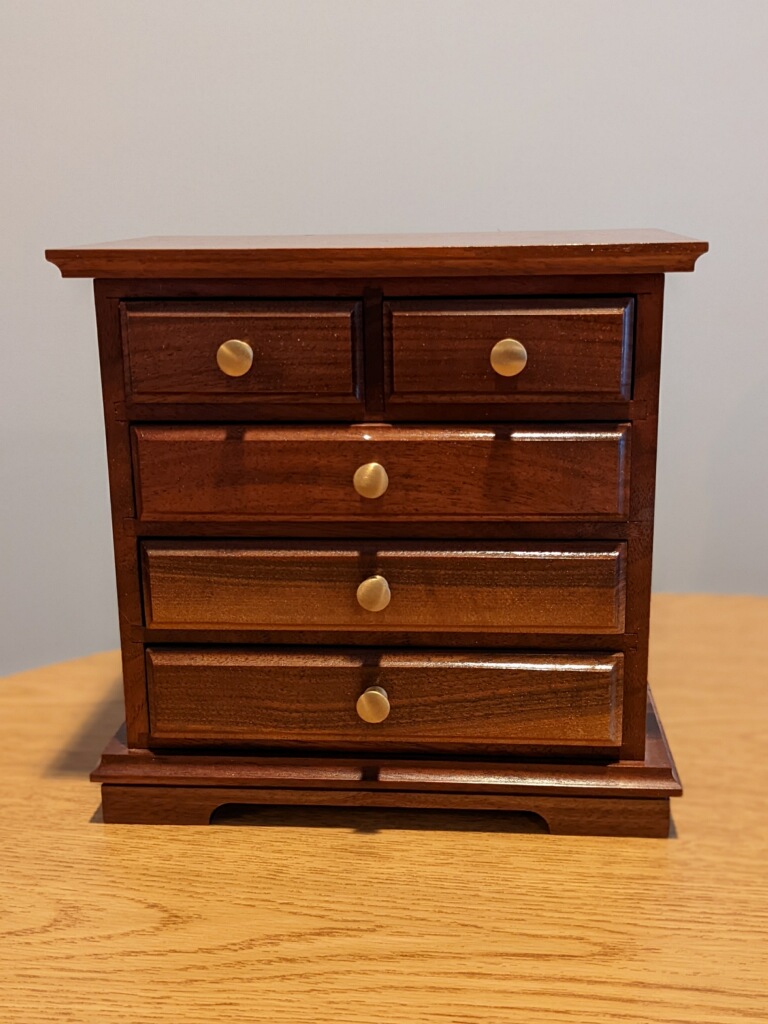
Black Walnut Jewelry Box

A friend of mine had a wedding planned for the spring of 2020 so I decided to make a trinket box as a wedding gift. Well, we know how 2020 went and the box ended up sitting in my living room for two years. I sent it off last week.

The box is made from wood salvaged from an old black walnut tree that stood in Decatur, Georgia until it became a hazard and had to be felled. After the main trunk and big pieces were cut up and sold, the property owner offered the scraps to whomever wanted them and I grabbed some of it. Walnut is a hard wood to work and I didn’t make anything with it for years, even transporting the lot from Atlanta to Oregon when we moved. The trinket box seemed like the perfect opportunity to use the old walnut and it was fun to make even if the wood was difficult to work (quite a few failures due to the wood cracking and chipping). All of the scrap pieces were/are very rough cut with absolutely no straight edges. My table saw, band saw and planer got a real workout in getting pieces to the right size.

Initially, I wanted to use some sort of interlocking joinery but found the walnut was just too brittle and difficult to deal with, so I ended up with a lot of glue joints. Not ideal and I hope it hopes together for a good number of years.

Here’s a photo of it in its new home.

Chuck

2006-2022

With all pet owners and animal people, there’s I think that one special creature that stands out from the rest. The best pet ever. For me, that would be Chuck, my Little Buddy. My best friend and near constant companion for sixteen years.

We lost Chuck last week after an extended bout with cancer, a foe he had bested two years ago in their first encounter with a year-long regimen of chemo. But cancer eventually won the war and Chuck passed from our lives and hearts peacefully, painlessly, as we cared for him best we could. I miss him so much.

Air Filtration Unit #3

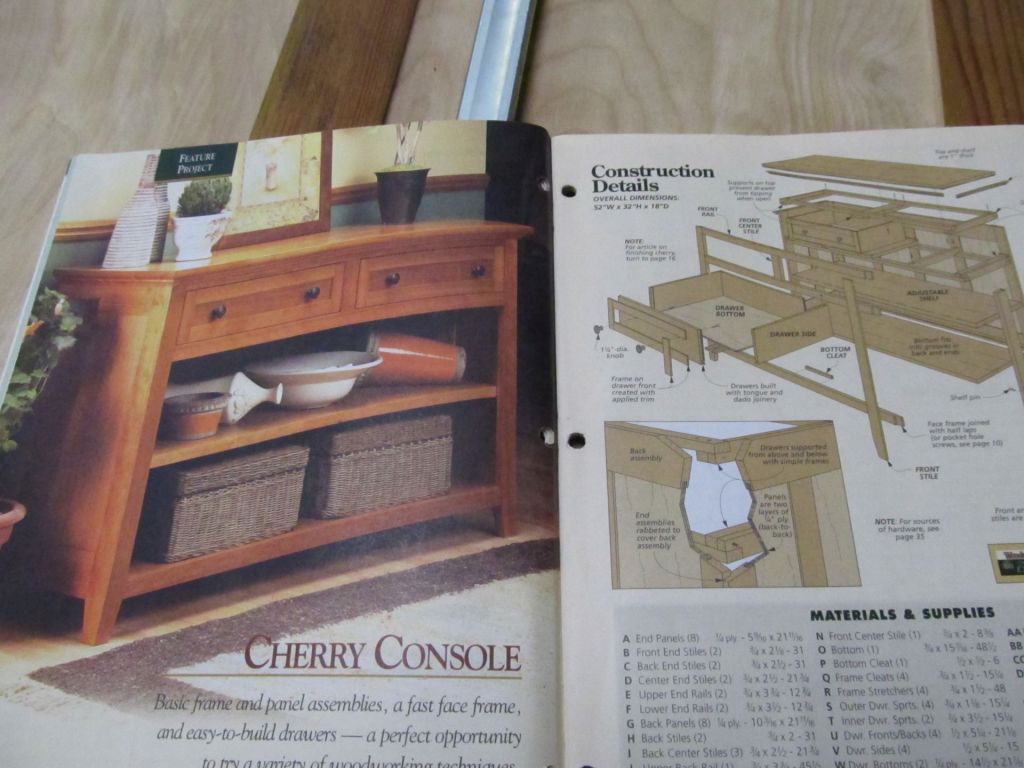
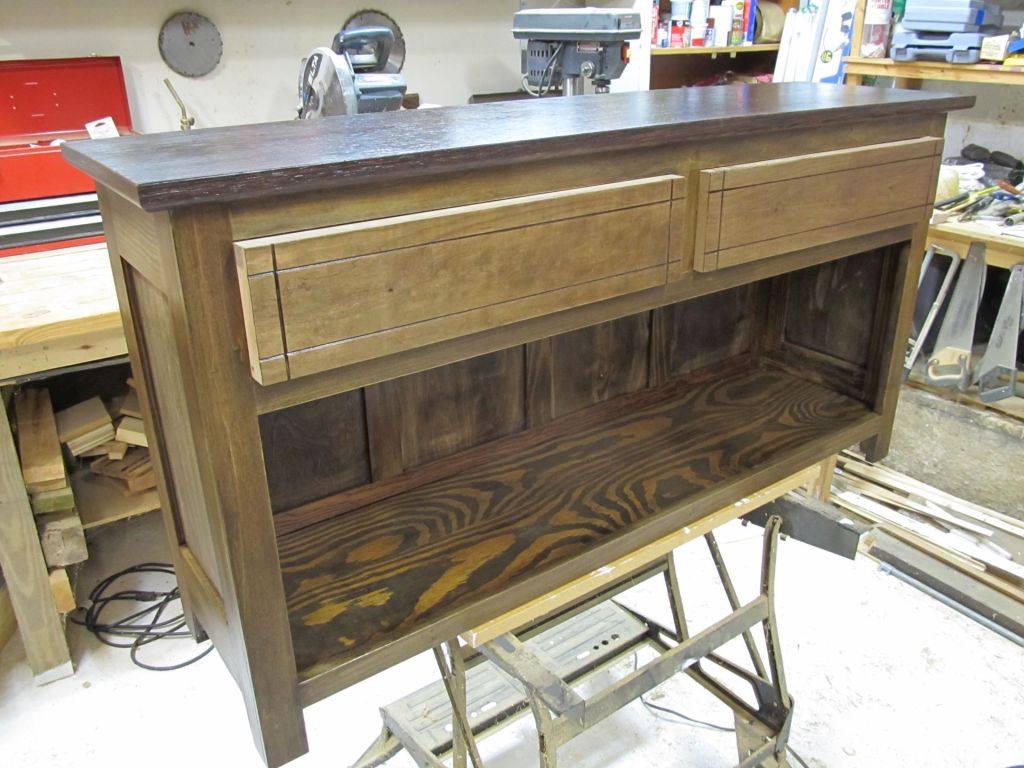
About a dozen years ago, I decided to build a TV console to help de-clutter the various devices feeding our television. It wasn’t meant to be a super nice piece of furniture, mainly because I decided to build it mostly out of scraps of various species of wood I had on hand. Except for the top – that would be from a really nice piece of wenge I obtained years earlier for a project that never came to fruition. The basic design came from an article in a woodworking magazine:

Here’s a few photos from the build:

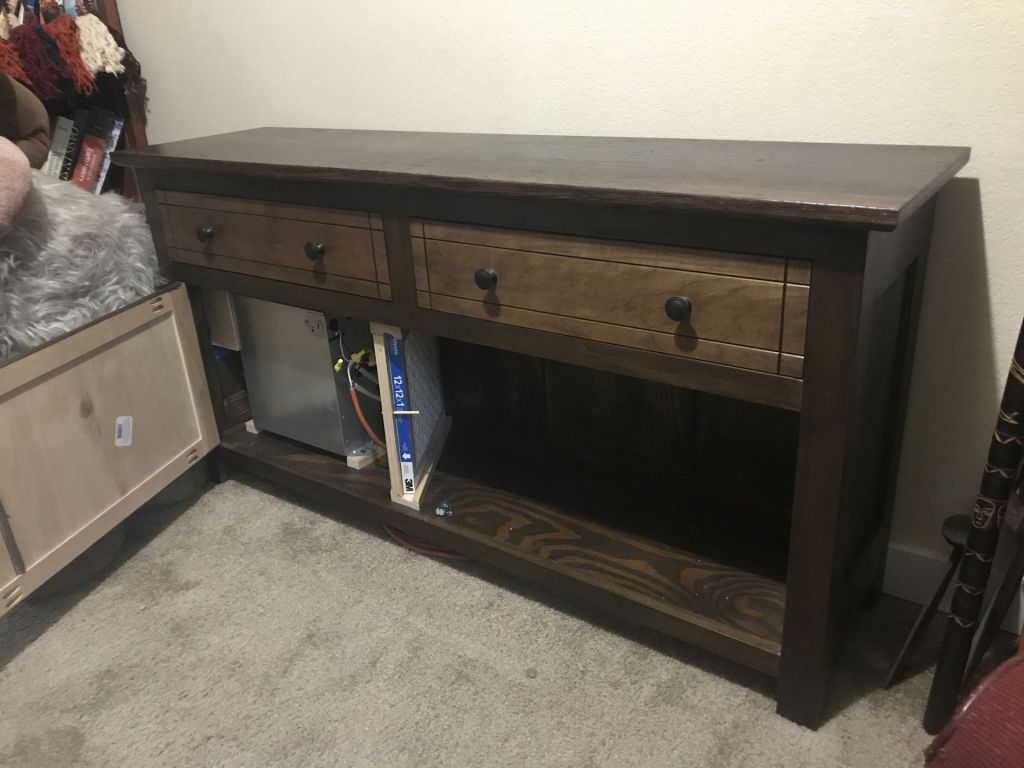
And the finished product (probably should have dusted the top before taking the photo):

So that’s the starting point for this latest air filter project. In an earlier post, I detailed how I built an end table filtration unit using an ultra quiet bathroom fan and a 12 x 12 near-HEPA filter. That worked out pretty well – we get a lot of wildfire smoke in central Oregon. In the bedroom, I’ve been using the first filtration unit, which is a stand-alone piece that doesn’t double as a piece of furniture. But, although it probably works better than the end table unit because of its larger filter (12 x 24), it’s kind of ugly. We’ve moved since I built the TV console and it now serves as an end of the bed … cabinet, table, whatever you call that sort of thing. A couple of months ago, I was staring at it (and I think I will just refer to it as a TV console) and thought that we really didn’t use the four baskets that sit on the lower shelf all that efficiently. And I looked at the ugly filter unit. What if I replaced two of those baskets with a fan & filter and installed a door? Yep, I’m doing it.

I’ve learned a bit from the first two filter projects (the ugly one and the much nicer end table) so installing the fan and filter in the TV console went a lot smoother. The challenges are two-fold. First, I had to figure out how to orient the fan so the exhaust port points in a direction away from the filter – doesn’t do any good to promote a circulation loop – and where I could easily breach the side panel of the console. The other units had four inch dust collection fittings installed to accept a hose. This one would just exhaust directly out the side with no hose. Second, I had to figure out how to mount a filter so it could be replaced easily. The first unit – with the bigger 12 x 2 filter – kind of failed that criterion as it requires removing several screws to get at the filter. The second unit – the end table – has the fan sitting horizontally with the filter resting on top in a custom frame. Very easy to change out by opening the louvered front door. The TV console couldn’t use either of those configurations. The depth of the console is less that 12 inches, so the fan had to be aligned vertically and the 12 x 12 filter had to be angled to fit. Took a little experimentation but I think I managed to nestle both inside the console nicely. The air is drawn from the right side where the two remaining baskets sit, and is exhausted through a port in the left side. There’s a screen covering the port. As with the end table unit, along with an on/off switch, there’s an electrical outlet for convenience. Not sure what we might plug in but it’s there.

There was actually a third challenge, one I couldn’t manage quite as well. Because the TV console was built with several species of wood, I tried to get them all to ‘blend’ by using a dark stain. Either black cherry or walnut, I forget. It worked out OK, not great. But now I was adding a front panel door of yet another species. And as I mentioned, I couldn’t remember the stain I used. The final result is also just OK. Given the bedroom is usually fairly dark , it’ll do.

The filter is easy to change. Two strips of wood are dado-ed to loosely accept the filter and I installed weatherstripping front and back to seal it in fairly snugly. A wooden dowel holds the filter against the rear weatherstripping and the door latch is set to seal the front weatherstripping against the filter frame. Just open the door, pull the dowel and slide the filter in or out. All the other avenues of air leakage are sealed as well, so essentially all the air drawn through the fan goes through the filter and out the exhaust port. A little might leak out around three sides of the door but not much.

The finished product:

Having the console down in the woodshop opened up the bedroom a bit, so I decided to place the finished piece against a wall until we need it. It’s easy enough to slide it over the the end of the bed when the air quality gets bad, as it inevitably will again next summer, and the summer after that.

Next up, a filtration unit for my neighbor. When the air was really bad this year, I quickly cobbled up a fan-filter for her to help alleviate headaches and such. Her unit will essentially be a copy of my end table piece, sized to fit.

One Veteran’s View of War

Every gun that is made, every warship launched, every rocket fired signifies, in the final sense, a theft from those who hunger and are not fed, those who are cold and are not clothed.
This world in arms is not spending money alone. It is spending the sweat of its laborers, the genius of its scientists, the hopes of its children. The cost of one modern heavy bomber is this: a modern brick school in more than 30 cities. It is two electric power plants, each serving a town of 60,000 population. It is two fine, fully equipped hospitals. It is some fifty miles of concrete pavement. We pay for a single fighter with a half-million bushels of wheat. We pay for a single destroyer with new homes that could have housed more than 8,000 people. . . . This is not a way of life at all, in any true sense. Under the cloud of threatening war, it is humanity hanging from a cross of iron.

President Dwight Eisenhower, General of the Army (Ret), April, 1953